
Wolfgang Lackerschmid
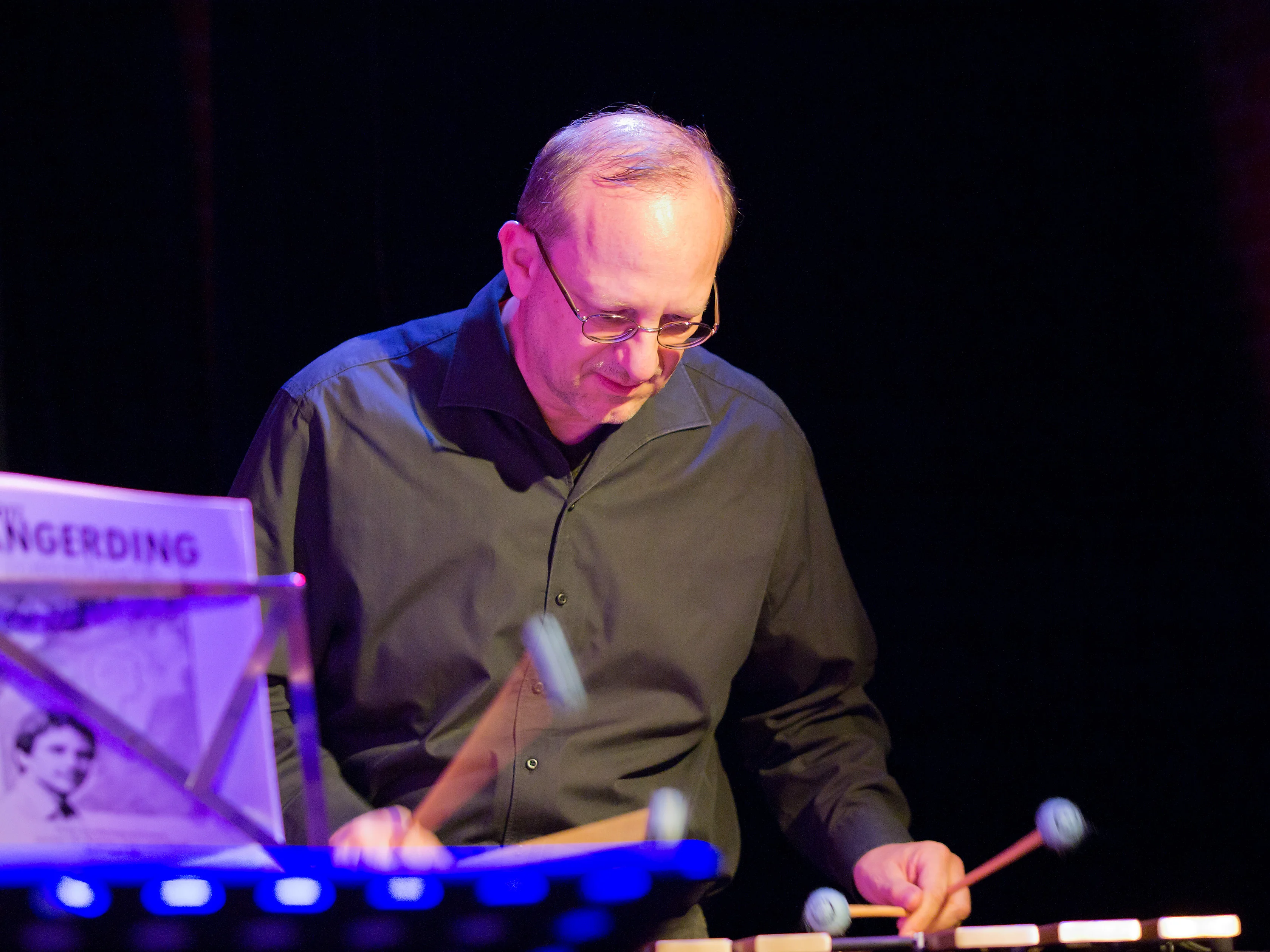
Image from Wikipedia
Image from Wikipedia
Wolfgang Lackerschmid – the vibraphonist who gave German jazz its own color
A life between vibraphone, composition, and European jazz history
Wolfgang Wilhelm Lackerschmid, born on September 19, 1956, in Tegernsee, is among the most influential German jazz musicians of his generation. As a vibraphonist, bandleader, and composer, he has developed an artistic identity that combines virtuosity, melodic precision, and compositional foresight. His musical profile extends far beyond the vibraphone, as he also plays piano and mallet instruments like the marimba. (de.wikipedia.org)
His career serves as an example of consistent artistic development: from studying composition, music theory, and percussion in Stuttgart to early formations of his own and international collaborations that made him a visible figure in the European jazz scene. Lackerschmid represents a jazz that is never merely reproduced but shapes, expands, and tells stories. His musical career thrives on sonic openness, stylistic curiosity, and a keen sense of interplay. (de.wikipedia.org)
Early years and musical influences
Wolfgang Lackerschmid grew up in Ehingen on the Danube and studied from 1975 to 1980 at the University of Music and Performing Arts Stuttgart. There, he studied composition and music theory with Martin Gümbel and percussion with Gyula Rasz. This education laid the foundation for a musician who would later excel not only as a soloist but also as an arranger and composer. (de.wikipedia.org)
In 1976, he founded his Mallet Connection and recorded the eponymous LP in the same year. On this early recording, he collaborated with musicians such as Rocky Knauer, Gerhart Ziegler, Janusz Stefanski, Dieter Bihlmaier, Leszek Zadlo, and Herbert Joos. Here, the signature of the young artist already emerges: an open, dialogic sound that brings rhythm, harmony, and improvisation into a clear musical context. (de.wikipedia.org)
The breakthrough in the European jazz scene
A crucial step in his career came in 1978 when Joachim-Ernst Berendt invited him along with Karl Berger, David Friedman, and Tom van der Geld to the first Vibraphone Summit. This meeting was more than a showcase: it anchored Lackerschmid in an international network of vibraphonists and made him audible as a distinctive voice beyond Germany. (de.wikipedia.org)
His most significant collaboration began in January 1979 with Chet Baker. Following a meeting at a festival, the idea for a duo album emerged, which was recorded a few months later in Stuttgart. Ballads for Two and the subsequent Chet Baker/Wolfgang Lackerschmid remain among the most renowned documents of his career and mark a moment where musical personality and historical significance converge. (de.wikipedia.org)
Collaboration with great names and stylistic breadth
Over more than 200 recordings and countless live concerts, Lackerschmid has worked with an impressive list of international stars, including Chet Baker, Attila Zoller, Larry Coryell, Buster Williams, Paquito D’Rivera, Tony Scott, Jacques Loussier, Eberhard Weber, Albert Mangelsdorff, and Wolfgang Dauner. This continuity over decades attests to his reliability as a partner in an ensemble and his ability to assert himself in very different musical contexts. (proton-berlin.de)
Particularly important to him has been the work in his own and co-led formations. These include Wolfgang Lackerschmid Connection, Wolfgang Lackerschmid & The Brazilian Trio, and the duo with Stefanie Schlesinger. His projects demonstrate a distinct signature: melodic clarity, rhythmic agility, and a fine balance between composition and improvisation. (proton-berlin.de)
Composition, theater, and an expanded concept of jazz
Lackerschmid is not just an interpreter but a prolific composer with a broad artistic spectrum. He has written numerous songs and jazz pieces, as well as concert works for orchestra, choir, and ensembles, as well as music for theater, ballet, film, and radio play. With this, his work consistently transcends the boundaries of conventional jazz and positions him as a musician with a cultural-historical scope. (proton-berlin.de)
An early example of this was in 1988 when he received a commission for ballet music for Snow White at the Augsburg City Theater. Later, further projects emerged in the intersection of jazz and contemporary music, including his ensemble Living Chamber Music for new works bridging jazz and art music. Lackerschmid thinks about music not only in songs but in forms, textures, and stage concepts. (de.wikipedia.org)
Discography and important releases
Wolfgang Lackerschmid's discography documents a continuous journey through various jazz aesthetics. Among the early and formative releases are Mallet Connection, Balzwalz, Vibes Summit, Chet Baker/Wolfgang Lackerschmid, Ballads for Two, and Live Conversation. These albums already showcase a musician in the late 1970s and early 1980s who carefully arranges timbres while simultaneously creating space for open improvisation. (de.wikipedia.org)
In the 1990s and beyond, his production remained remarkably prolific. Notable titles include One More Life, Live Highlights ’92, Chet in Europe, New Singers / New Songs, Angel Eyes, Polish Wind, Hurry Up and Wait, and Lockdown Releases. Particularly, the re-releases and archive projects show how strongly Lackerschmid's work has been received and curated across different phases. (de.wikipedia.org)
Special attention was also given to the re-release of Ballads for Two by Dot Time Records in 2018, as well as the re-release of Originals as Welcome Back in 2023. Such reissues situate Lackerschmid's catalog not only historically but also currently: as a corpus of recordings that have remained relevant to the history of jazz. (de.wikipedia.org)
Style, stage presence, and musical signature
His style combines technical control with a notably light, often dance-like manner of playing. A press description explicitly highlights his way of drawing rapid chord progressions across the surfaces with four mallets; at the same time, the agility and ease of his playing are emphasized. This represents a key to his artistic impact: Lackerschmid never sounds heavy-footed, but rather transparent, agile, and always focused on the phrase. (proton-berlin.de)
The press also praises the melodic quality of his compositions. The Augsburg Allgemeine described his works as "always up to date," highlighting a trait that has shaped his career for decades: Lackerschmid does not compose retrospectively but with a view towards the present and open form. This makes him appealing both to jazz purists and to listeners who appreciate sonic delicacy and structural elegance. (augsburger-allgemeine.de)
Brazilian influences and international openness
A recurring theme in Lackerschmid's career is his affinity for Brazilian music. With Wolfgang Lackerschmid & The Brazilian Trio, he has been developing a repertoire since 2014 that thrives on Brazilian rhythms, harmonic sophistication, and buoyant grooves. The lineup featuring Hélio Alves, Nilson Matta, and Duduka da Fonseca references an international jazz language that intentionally loosens stylistic boundaries. (de.wikipedia.org)
His collaboration with Stefanie Schlesinger also belongs in this extended musical cosmos. Since 2000, both have performed in various duo and band projects; together, they have developed a stage format that combines music theater and jazz. This connection of vocal expressiveness and instrumental tonal color expands Lackerschmid's profile beyond the classic instrumental role. (de.wikipedia.org)
Current projects, tour activity, and presence
Wolfgang Lackerschmid remains artistically active. The current tour dates show numerous performances in 2025 with Trio 77, the Schlesinger-Lackerschmid duo, projects with Markus Lüpertz, as well as international engagements like concerts in Tel Aviv. The image is that of a musician who is not managing his career but expanding it. (proton-berlin.de)
Additionally, he is firmly rooted in Augsburg, where he lives and operates a recording studio. He is institutionally engaged as a deputy member of the board of GEMA, on the board of jetzt:musik! Augsburg Society for New Music e. V., as chair of the jazz committee in the Tonkünstlerverband Bayern, and as a member of the German Cultural Council in the copyright committee. These roles underscore his authority far beyond the stage. (de.wikipedia.org)
Cultural influence and musical significance
Wolfgang Lackerschmid embodies a German jazz tradition that remains accessible internationally without denying its origins. His biography connects academic training, early ensemble work, international collaborations, and compositional independence into a cohesive artist profile. Particularly in the intersection of jazz, contemporary music, and theatrical work, he has established himself as a significant voice. (de.wikipedia.org)
His significance is also evident in the fact that he remains continuously present in discographies, concert announcements, reviews, and re-releases. This speaks to substance: music of lasting quality does not arise from volume but from form, attitude, and recognizability. Lackerschmid embodies these qualities with a rare mix of elegance, precision, and artistic independence. (de.wikipedia.org)
Conclusion: A jazz artist with sonic authority and vibrant presence
Wolfgang Lackerschmid is compelling because he understands jazz as an open art form: as dialogue, as composition, as a stage event, and as cultural responsibility. His career spans from early recordings through collaboration with Chet Baker to current ensemble projects and showcases a rare continuity. Those who love music that combines substance, delicacy, and historical depth will find in him an artist of enduring relevance. (de.wikipedia.org)
A live experience with Wolfgang Lackerschmid is worthwhile because his stage presence unleashes that mix of concentration, lightness, and sonic imagination that makes a difference in jazz. His music remains agile, elegant, and surprising – and therein lies its lasting fascination. (proton-berlin.de)
Official channels of Wolfgang Lackerschmid:
- Instagram: No official profile found
- Facebook: No official profile found
- YouTube: No official profile found
- Spotify: No official profile found
- TikTok: No official profile found
Sources:
- Wikipedia – Wolfgang Lackerschmid
- Wikipedia – Wolfgang Lackerschmid/Diskografie
- ProTon Music Agency – Wolfgang Lackerschmid (Info in English)
- ProTon Music Agency – Wolfgang Lackerschmid Connection Press
- ProTon Music Agency – Wolfgang Lackerschmid & The Brazilian Trio
- ProTon Music Agency – Tour Dates
- Augsburger Allgemeine – 65th Birthday: Wolfgang Lackerschmid
- Wikipedia: Image and text source
Upcoming Events
Steinklang - Concert Series
Steinklang
Steinklang - Concert Series in the Dominican Church
Steinklang - Concert Series
Steinklang - Concert Series at the Dominican Church
Steinklang - Concert Series
34. International Augsburg Jazz Summer
Wolfgang Lackerschmid Quartet
Sensemble Season Kickoff Fest 2026