
Katrin Krabbe
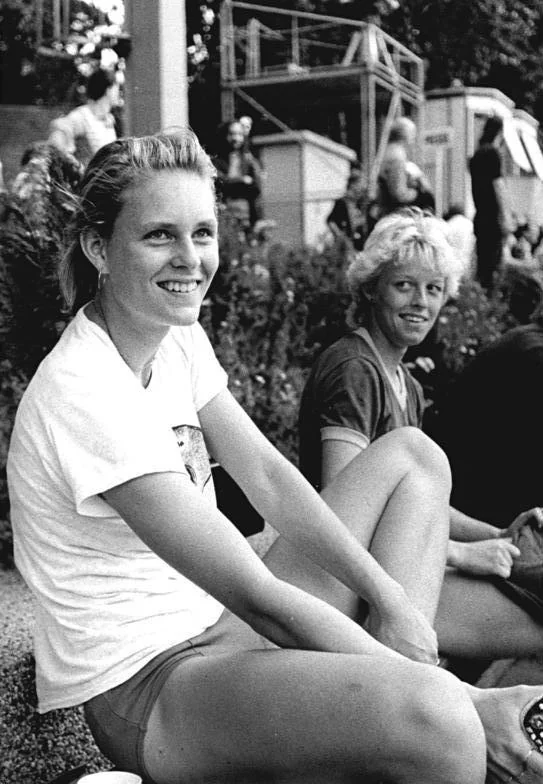
Image from Wikipedia
Image from Wikipedia
Katrin Krabbe: The Sprinter Who Shaped the German Athletics Moment of Her Time
From Promising Talent to World-Class: The Explosive Career of an Exceptional Sprinter
Katrin Krabbe, born on November 22, 1969, in Neubrandenburg, is one of the most prominent figures in German athletics history. She became known as a sprinter over 100 and 200 meters and reached the peak of her sports career in the early 1990s when she unexpectedly became a double world champion in Tokyo in 1991. These achievements not only made her the World Athlete of the Year but also the World Sportswoman of the Year in 1991. ([de.wikipedia.org](https://de.wikipedia.org/wiki/Katrin_Krabbe?utm_source=openai))
Her name represents a rare mix of speed, dominance, and public attention. Even before her triumph at the World Championships, she had established herself internationally, including winning the European Championship title in 1990 in Split and achieving strong results at the 1991 World Championships. World Athletics still recognizes her as a double world champion and a triple European champion, underscoring her position in sprinting in the early 1990s. ([worldathletics.org](https://worldathletics.org/athletes/germany/katrin-krabbe-14343736?utm_source=openai))
The Early Years: A Talent from East German Athletics
Krabbe was born in Neubrandenburg and developed into an athlete with exceptional acceleration and high top speed in the performance-oriented East German sprint school. Her early successes are reflected in the official best performance statistics and competition results documented by World Athletics. Among other achievements, her personal best of 10.89 seconds over 100 meters in 1988 and 21.95 seconds over 200 meters in 1990 are recorded. ([worldathletics.org](https://worldathletics.org/athletes/germany/katrin-krabbe-14343736?utm_source=openai))
The sporting context of her development was formative: in East German athletics, sprinting was not only viewed as an individual discipline but also as a prestige project. Krabbe emerged from this system to reach the national and international elite, quickly becoming the face of a new era in which athletic successes were interpreted both in media and societal contexts. The official chronicle of World Athletics cites her title win in 1991 as the first world championship victory for a female athlete from unified Germany. ([worldathletics.org](https://worldathletics.org/heritage/news/zeitgeist-moments-world-athletics-championships?utm_source=openai))
The Breakthrough in Split and the Pinnacle in Tokyo
Krabbe experienced her breakthrough at the 1990 European Championships in Split. There, she asserted herself in the international sprint field and established herself as one of the fastest women in the world. Her times and results demonstrate that she relied not on chance but on a sporting profile of world-class level: reaction speed, clean running technique, and an exceptionally stable race distribution over 100 and 200 meters. ([de.wikipedia.org](https://de.wikipedia.org/wiki/Katrin_Krabbe?utm_source=openai))
The climax came at the 1991 World Championships in Tokyo. World Athletics documents her victory over 100 meters in 10.99 seconds and her dominance over 200 meters, where she set a standard for the season with 21.95 seconds. In the 200-meter final and the preceding rounds, she displayed a controlled sovereignty that is rarely seen in sprint history. ([worldathletics.org](https://worldathletics.org/competitions/world-athletics-championships/iaaf-world-championships-jpn-1991-6987209/results/women/100-metres/final/result?utm_source=openai))
Awards and Recognition: An Athlete at the Center of Sports
Krabbe's list of athletic accolades highlights her status: World Athletics lists her as a World Champion, and the International Athletics Foundation recognizes her as the World Athlete of the Year 1991. These honors marked the moment when she became not just a fast sprinter but also a symbol of German athletics at the highest level. ([worldathletics.org](https://worldathletics.org/athletes/germany/katrin-krabbe-14343736?utm_source=openai))
In media perception, she also became one of the standout sports figures of the early post-reunification era. This was not only due to the gold she earned on the track but also because of the rare convergence of peak performance, national reorganization, and enormous public projection. In this tension, Krabbe became one of the first major sports icons of unified Germany. ([focus.de](https://www.focus.de/sport/mehrsport/die-sprinterin-im-autohaus-katrin-krabbe-zum-40_id_1882379.html?utm_source=openai))
Doping Case, Suspension, and the Abrupt End of Her Career
In 1992, Krabbe's career faced a crisis when she was suspended for taking clenbuterol due to drug abuse. The suspension later became the subject of long-lasting legal disputes that extended into the mid-1990s and beyond. Reports from STERN and WELT describe the suspension as a de facto end to her career and depict the subsequent public pressure on the athlete. ([stern.de](https://www.stern.de/lifestyle/leute/was-macht-eigentlich-katrin-krabbe-3961160.html?utm_source=openai))
The case was particularly notable because Krabbe legally contested the extension of the suspension by the International Association of Athletics Federations and ultimately fought for compensation payments amounting to around 610,000 euros or 1.2 million Deutsche Marks. This achievement made legal history in sports in 2002, as such cases remain exceptional in international elite sports. Munzinger and the Wikipedia entry consistently reference this legal dimension of her case. ([munzinger.de](https://www.munzinger.de/register/portrait/biographien/krabbe-zimmermann%20katrin/01/3305?utm_source=openai))
Comeback Attempt and the End of Her Active Sporting Career
After the suspension, Krabbe attempted a comeback, which, however, did not restore her previous level of performance. The sources describe this phase as a failure of her return attempt, after which she ended her sports career. This break makes her biography particularly ambivalent: between her greatest triumph and abrupt downfall lies just a short period. ([de.wikipedia.org](https://de.wikipedia.org/wiki/Katrin_Krabbe?utm_source=openai))
This ambivalence continues to shape the perception of her career today. On one hand, there are world championship titles, European championship titles, and record entries; on the other, the question of how closely fame, performance pressure, and association rules in high-performance sports are intertwined. Krabbe's story is therefore not only a sprint story but also a chapter about responsibility, public perception, and the fragility of athletic careers. ([worldathletics.org](https://worldathletics.org/athletes/germany/katrin-krabbe-14343736?utm_source=openai))
Later Years and a New Life Away from the Stadium
Later media reports depict Krabbe living a life far from the international stage. WELT reported that she is involved in accompanying severely ill people, choosing a profession that is associated with great human closeness. This change underscores how significantly her life path has realigned after the end of her sprinting career. ([welt.de](https://www.welt.de/sport/article162894702/Katrin-Krabbe-Ehemalige-Sprinterin-begleitet-Menschen-beim-Sterben.html?utm_source=openai))
Journalistic retrospectives also describe her as a personality whose name still remains linked to German athletics of the 1990s. Her biography provides not only a retrospective on athletic excellence but also a reflection on the consequences of public expectation and the search for a second chapter in life. ([saechsische.de](https://www.saechsische.de/lokales/das-macht-katrin-krabbe-heute-HD72224F6EXX6QDNCKJONFGB7U.html?utm_source=openai))
Discography, Social Media, and Current Projects: Not Present for Katrin Krabbe
Since Katrin Krabbe is not a musician, there is no discography, no current music projects, and no official social media channels in the sense of an artist career. Web research revealed no verified official Instagram, Facebook, YouTube, Spotify, or TikTok profiles that can be definitively attributed to her. Therefore, there is also no "Fan Voices" section. ([de.wikipedia.org](https://de.wikipedia.org/wiki/Katrin_Krabbe?utm_source=openai))
Conclusion: Why Katrin Krabbe Continues to Fascinate
Katrin Krabbe remains one of the most compelling figures in German sports history because her career encompassed everything in a short time: triumph, pressure of expectation, a significant fall, and legal aftermath. Her successes over 100 and 200 meters made her a world-class sprinter, while her later legal battle became a historical exception. Anyone who wants to understand the history of sports finds in her one of the sharpest, most impressive narratives of the post-reunification period. ([worldathletics.org](https://worldathletics.org/athletes/germany/katrin-krabbe-14343736?utm_source=openai))
This blend of glamor and break, dominance and vulnerability makes her biography intriguing. Katrin Krabbe stands for an era in which peak athletic performance carried immense cultural significance. Her story warrants a renewed reading as it shows how quickly a world star becomes a legend with a complicated legacy. ([focus.de](https://www.focus.de/sport/mehrsport/die-sprinterin-im-autohaus-katrin-krabbe-zum-40_id_1882379.html?utm_source=openai))
Official Channels of Katrin Krabbe:
- Instagram: No official profile found
- Facebook: No official profile found
- YouTube: No official profile found
- Spotify: No official profile found
- TikTok: No official profile found
Sources:
- Wikipedia – Katrin Krabbe
- World Athletics – Katrin Krabbe Profile
- World Athletics – Greatest World Championships moments
- Munzinger Biography – Katrin Krabbe-Zimmermann
- STERN – What is Katrin Krabbe Doing Nowadays?
- WELT – Katrin Krabbe Accompanies People in Dying
- FOCUS Online – The Sprinter in the Car Dealership: Katrin Krabbe Turns 40