
Benedikt Hipp
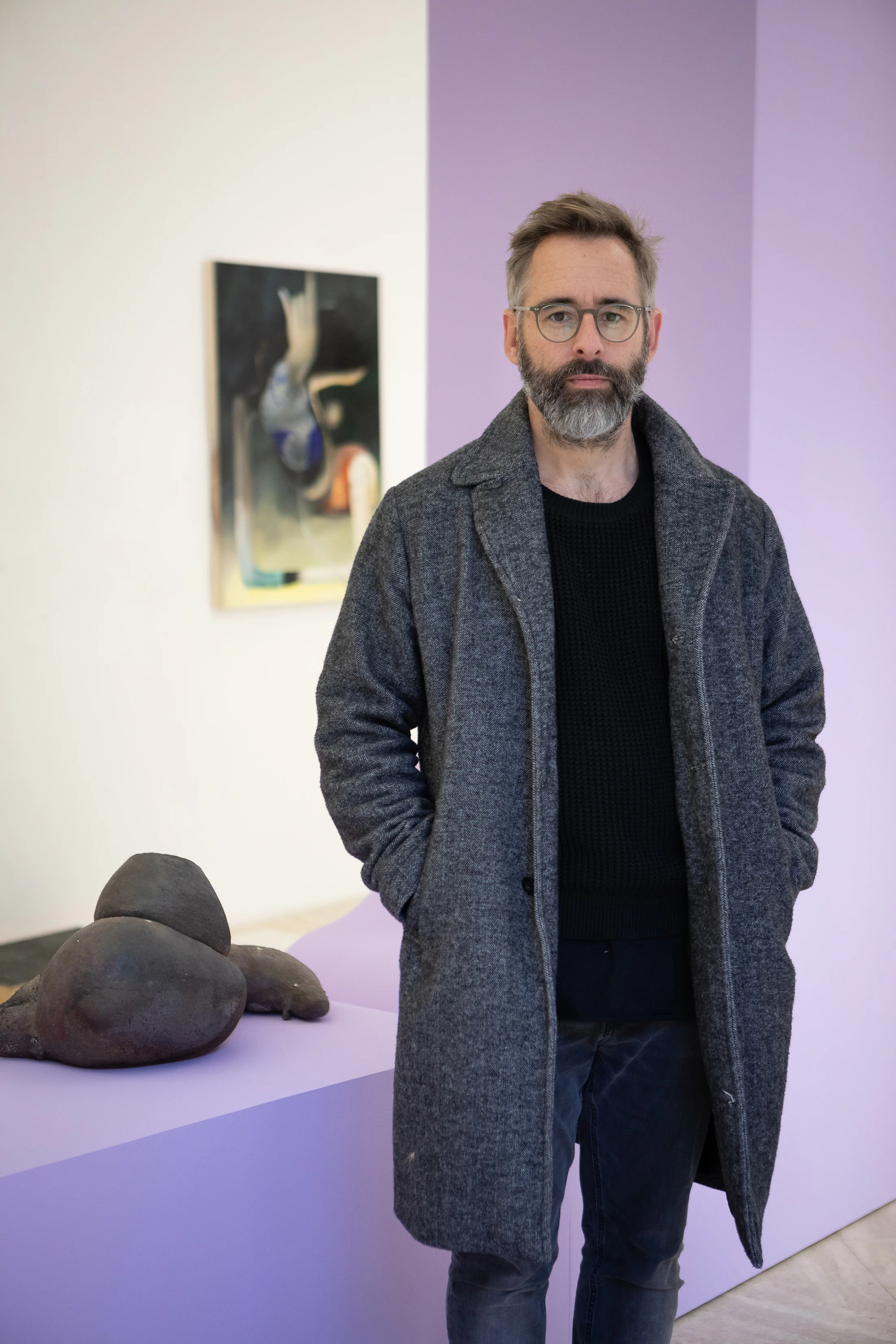
Image from Wikipedia
Image from Wikipedia
Benedikt Hipp – Between Figure, Space, and Existential Visual Language
An artist redefining perception, body, and space
Benedikt Hipp, born in 1977 in Munich, is among the prominent German artists of his generation. He lives and works between Munich and Rome and has developed a distinctive oeuvre through painting, drawing, sculpture, and site-specific installations. His works have been exhibited, among others, at the Haus der Kunst in Munich, the Schirn Kunsthalle Frankfurt, the Wilhelm-Hack-Museum in Ludwigshafen, and the CAPC in Bordeaux. In 2020/21, he received the Rome Prize of the Federal Republic of Germany, accompanied by a residency at the Deutsche Akademie Villa Massimo in Rome. ([de.wikipedia.org](https://de.wikipedia.org/wiki/Benedikt_Hipp?utm_source=openai))
Biography and artistic education
From Munich to Nuremberg and Bologna to contemporary European art
Hipp's education began at the Academy of Fine Arts Nuremberg, followed by the Academy of Fine Arts Munich and the Accademia di Belle Arti in Bologna. He completed his diploma in Munich in 2007 under Sean Scully. These phases explain the formal precision of his works as well as his openness to European pictorial traditions, architectural spaces, and philosophical questions. An artistic development emerged early on that was not confined to a single medium but conceptualizes painting, object, installation, and text as an interconnected system. ([benedikthipp.de](https://www.benedikthipp.de/cv?utm_source=openai))
Fellowships, residencies, and international grounding
Key support for Hipp includes the Villa Massimo 2020/2021, a fellowship from the Free State of Bavaria, the catalog fellowship from Kunstfonds Bonn, as well as earlier awards such as the culture prize from the city of Pfaffenhofen and the culture prize for young artists from Upper Bavaria. His stays in Rome, Mallorca, and other European art centers have not only connected his work internationally but have also thematically expanded it. The connection of place, body, and image space is central to his work. ([benedikthipp.de](https://www.benedikthipp.de/cv?utm_source=openai))
Career and exhibitions
From early galleries to institutional major projects
Hipp’s exhibition history shows a continuous rise across renowned galleries and museums. He presented his works in Munich as early as 2004, followed by solo exhibitions in Karlsruhe, Erlangen, Bielefeld, Düsseldorf, Ludwigshafen, Basel, Rome, Milan, and most recently in 2025 in Lisbon with SORE SPOT. Concurrently, he was represented in institutional settings, such as Eppur si muove in Dresden or thematic group exhibitions in museums and art houses. ([benedikthipp.de](https://www.benedikthipp.de/cv))
Spatial staging as part of the narrative
Hipp’s handling of exhibition spaces as walkable visual compositions is particularly formative. The Frieze review of Luxstätt describes how he repositioned walls, created platforms, ramps, and passages, thereby transforming painting, drawing, sculpture, and installation into a non-linear dramaturgy. Instead of a static white-cube concept, Hipp creates a scenographic structure where the work not only occupies but also shapes the space. ([frieze.com](https://www.frieze.com/article/benedikt-hipp))
Works, motifs, and formal development
The body as fragment, mask, and conceptual figure
A recurring theme in Hipp's work is the body. His official website states that in paintings and three-dimensional works, the body appears as a recognizable figure, a fragmented body, or an abstract unity. Julienne Lorz further emphasizes that body and space interact reciprocally in his work, remaining in a tension between figuration and abstraction. This connection makes Hipp’s visual world so unmistakable: it is sensual but never illustrative; physical but never naturalistic. ([benedikthipp.de](https://www.benedikthipp.de/texts/blind-faith-julienne-lorz-2018-english?utm_source=openai))
Masks, shadows, overlays
Artsy describes Hipp’s portraits as images in which identity, individuality, and autonomy of the modern subject are questioned. Faces are overlaid with shadows, masks, color spots, and patterns; the figure remains present but eludes definitive readability. Frieze highlights that Hipp’s originally dark painting has developed to become more colorful and open over the years, with collage, paper fragments, and three-dimensional arrangements becoming more prominent. ([artsy.net](https://www.artsy.net/artist/benedikt-hipp))
Drawing, painting, and ceramic sculptures
Hipp's work includes not only oil paintings on wood or MDF but also works on paper, collages, and ceramic sculptures. The text for I Gotta Human Face emphasizes the role of ceramics as an archaic, material-centric process that holds significant importance in Hipp’s practice. In the project MAGMA, wood-fired ceramics and oil paintings are brought together, creating a dialogue between surface, material tension, and plastic density. ([benedikthipp.de](https://www.benedikthipp.de/texts/i-gotta-human-face-exhibition-text-by-luisa-seipp-english?utm_source=openai))
Current projects and recent presence
2024 and 2025: new exhibitions and visibility
The current state of work and exhibitions shows Benedikt Hipp maintaining a high presence. In 2024, Deep Sea Sky High was listed at the Starnberger See Museum, followed in 2025 by SORE SPOT at Monitor in Lisbon, a group exhibition at the 16th Triennale Kleinplastik Fellbach, and a participation in the Heiner Hoerni collection exhibition at the Kunstmuseum Thurgau. These projects underscore that Hipp’s artistic development appears ongoing, continually shifting into new contexts. ([benedikthipp.de](https://www.benedikthipp.de/news))
Reception, significance, and art historical positioning
Between modern image criticism and mythical condensation
Art critics often read Hipp’s work as an engagement with the modern conception of humanity. Jörg Scheller describes an early critique of ideas surrounding individuality, identity, and autonomy of the subject; both Frieze and Artsy highlight connections to art historical references such as Goya, de Chirico, Schwitters, or Lissitzky. As a result, a body of work emerges that does not merely cite historical references but productively transforms them into a contemporary visual language. ([benedikthipp.de](https://www.benedikthipp.de/texts/pneumopathology-and-dividuality-2015-dr-j%C3%B6rg-scheller-english?utm_source=openai))
Hipp’s cultural influence lies precisely in this dual movement: His works are intellectually dense while simultaneously remaining immediately enigmatic. They transform pictorial spaces into spaces of thought and challenge viewers to read figures, materials, and architectural settings as part of a larger narrative. This is where the strength of his art lies: it combines painterly authority with installational presence while remaining open to new interpretations. ([benedikthipp.de](https://www.benedikthipp.de/texts/blind-faith-julienne-lorz-2018-english?utm_source=openai))
Conclusion
Benedikt Hipp is compelling because he thinks beyond the confines of the classical panel painting while simultaneously developing a highly concentrated, recognizable visual language. His works revolve around body, identity, space, and material, without ever exhausting themselves in a single formula. Visitors to his exhibitions experience art as a precisely staged experiential space, where painting, sculpture, and architecture intertwine. This is precisely why it is worthwhile to experience Benedikt Hipp live. ([benedikthipp.de](https://www.benedikthipp.de/cv))
Official channels of Benedikt Hipp:
- Instagram: no official profile found
- Facebook: no official profile found
- YouTube: no official profile found
- Spotify: no official profile found
- TikTok: no official profile found