Urban Transformation in Straubing: New Projects & Housing
Urban Transformation in Straubing: New Neighborhoods & Projects That Will Shape the Coming Years
Note on timeliness: This article describes only future projects and plans. Schedules and designs may change due to decisions, funding commitments, tenders, or construction processes.
Why Straubing Is Facing Noticeable Change
Straubing will visibly change in several areas in the coming years: additional housing is planned, existing neighborhoods are to be stabilized both urbanistically and socially, and climate adaptation will play a greater role in the design of public spaces. At the same time, the Danube is expected to gain more importance as an urban space—not just as a landscape, but as a place for recreation and movement.
At its core, it is about three goals that are to interact in the future:
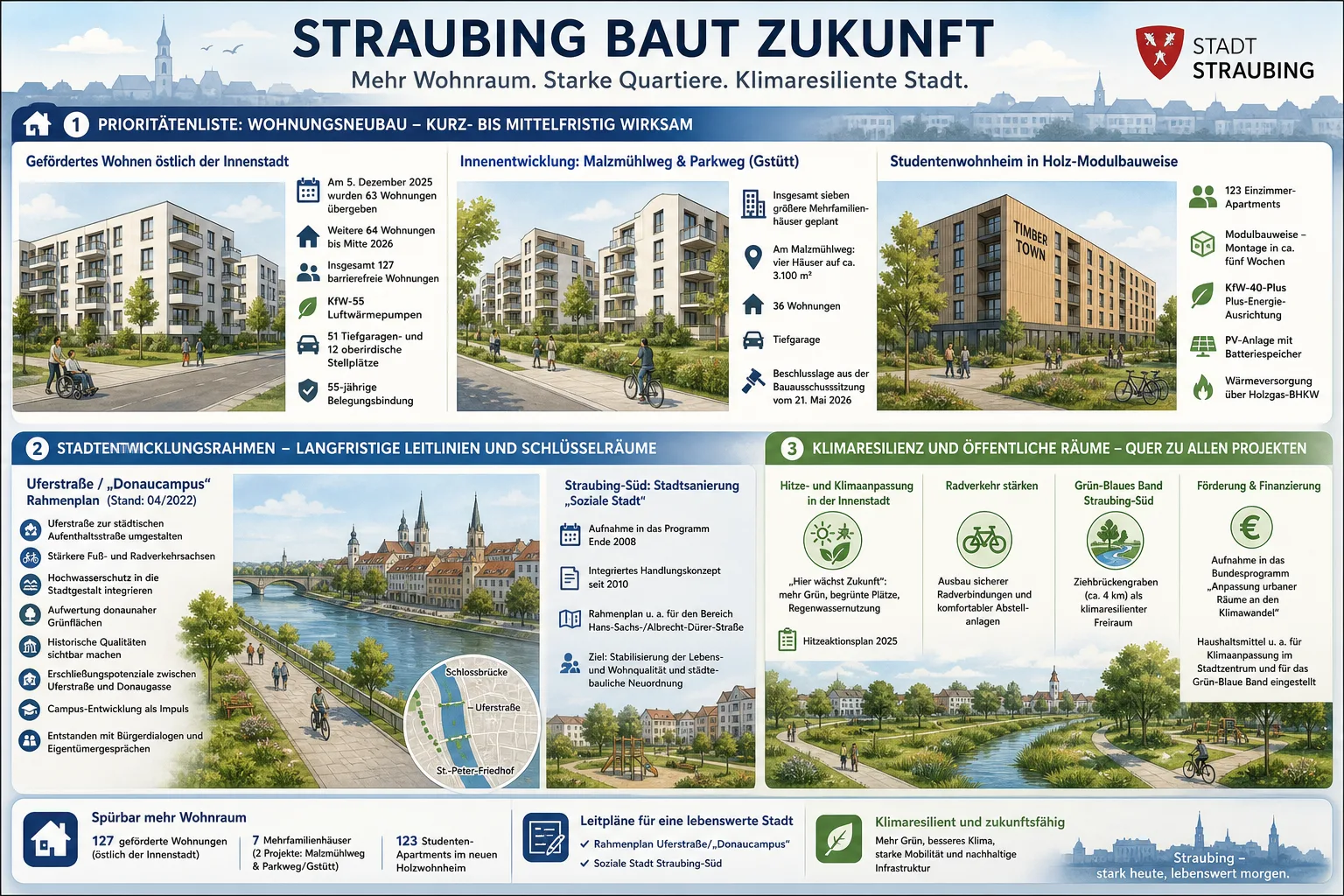
- Creating housing (including subsidized, low-barrier options),
- Further developing neighborhoods (renovation, open spaces, social infrastructure),
- Increasing climate resilience (shade, greenery, water, unsealing, heat protection).
How quickly these goals are achieved depends largely on permits, funding programs, tenders, construction capacities, and political decisions.
New Housing: Subsidized New Construction & Compact Neighborhoods
The housing market is also expected to remain under pressure in Straubing. This makes projects that will enable more housing in the future, while taking social and energy requirements into account, all the more important.
What will typically be decisive in the coming years
- Funding conditions and restrictions: In state-subsidized projects, occupancy restrictions and rent caps will influence long-term affordability.
- Accessibility: New buildings are expected to increasingly feature elevators, low-threshold access, and practical floor plans.
- Energy and heating concepts: Depending on the project, heat pumps, photovoltaics, and high efficiency standards may play a role; which standards apply specifically depends on the funding logic and year of construction.
- Inner development: Densification within the existing urban area is often used as a tool to limit land consumption.
For residents, this often means a phase with construction sites, detours, and construction logistics—but in the long term, also the chance for shorter distances to local amenities, education, and leisure if new construction and infrastructure are considered together.
Timber-Town & Campus: Timber Construction as a Building Block for Future Neighborhoods
Multi-story timber construction and modular construction methods are expected to become increasingly important in Germany—for reasons of construction time as well as resource efficiency. In Straubing, this approach will likely be particularly visible where living, studying, and urban space overlap spatially.
What expectations are realistic
- Faster realization: Modular systems can shorten construction times, provided planning, structural engineering, fire protection, and supply chains are coordinated early.
- Energy goals: Concepts such as PV systems, storage, and efficient heat supply will likely be considered more often in new housing projects.
- Urban space quality: It will be crucial whether ground floors, pathways, green spaces, and places to stay are planned so that a building also becomes a neighborhood building block.
Along the Danube and near the campus, planned measures will likely have to be measured by whether they improve not only traffic but also pedestrian and bicycle paths, safe crossings, good places to stay, and clear access to the water.
Renovation & Social City: Straubing-South as a Focus
Urban transformation does not arise solely from new construction. In the coming years, it will also depend on how Straubing stabilizes and further develops existing neighborhoods. Urban development funding programs (often known as "Social Cohesion"/formerly "Social City") typically aim to improve public spaces, strengthen social infrastructure, and upgrade neighborhood centers.
What measures are typically part of such neighborhood processes in the future
- Upgrading squares, paths, and green spaces (lighting, furniture, accessibility, sense of security),
- Improved pathways (school routes, crossings, cycling connections),
- Supplementary housing options (modernization, densification, partly new floor plans),
- Strengthening participation through neighborhood management, participation formats, and local projects.
For residents, the success of such projects will be shown above all by whether everyday life measurably improves: fewer conflicts in public spaces, better usability of open spaces, more meeting places, and a clearly recognizable benefit from the investments.
Climate Resilience: Green-Blue Corridor & Heat-Resistant Spaces
Heat waves and heavy rainfall risks are expected to become more frequent and relevant for urban planning. Therefore, in the coming years, Straubing will have to integrate measures that fall under climate adaptation more strongly into projects—in new construction, renovation, and the design of streets and squares.
What "green-blue" will mean in practice
- More shading: additional trees where site conditions allow,
- More water in urban space: retention, infiltration, open water features (if safe and maintainable),
- Unsealing: where possible, reduction of asphalted areas in favor of permeable surfaces,
- Cool corridors: connected green and water axes that can reduce heat stress.
In addition, instruments such as heat action planning and climate-adapted design of central squares are expected to gain importance. It is crucial that measures not only "look good" but that maintenance, irrigation, responsibilities, and financing are secured over the years.
"Climate adaptation succeeds when it becomes part of everyday life: shade where people walk and wait; water where it retains rain; and greenery that can be maintained in the long term."
Co-Design: Participation, Consideration, Transparency
For urban transformation to be accepted in the long term, Straubing will depend on comprehensible considerations in the coming years: between housing needs and open space protection, between traffic function and quality of stay, between construction costs and climate goals.
For citizens, it will be relevant when participation is possible and which questions are actually open. Typical occasions for participation are:
- Development plan procedures (early public participation and display),
- Framework plans and urban development concepts,
- Traffic studies and redesigns of street spaces,
- Neighborhood processes with neighborhood management.
If participation is designed seriously, it can make conflicts visible early (e.g., parking pressure, noise, routing) and improve solutions before they become expensive.
Practical Guidance: What Citizens, Students & Businesses Can Pay Attention To
For Apartment Seekers & Residents
- Early information: In subsidized projects, criteria and deadlines are often strict; those who inform themselves early can plan more realistically.
- Check everyday routes: Construction sites change routes; future cycling and walking paths can also bring advantages.
- Factor in noise and construction phases: Larger projects usually have construction phases; this helps to classify burdens over time.
For Students
- Understand energy and ancillary cost logic: Modern buildings may have different ancillary cost structures (e.g., electricity shares, shared systems, metering concepts).
- Consider mobility: Proximity to campus is an advantage if cycling and public transport connections grow with it.
For Local Businesses & Service Providers
- Opportunities in renovation & climate adaptation: Maintenance of greenery, unsealing, roof/facade greening, PV and heating technology are expected to be in greater demand.
- Transparency in tenders: Public projects follow formal awards; early observation can bring competitive advantages.
Sources & Further Links
- City of Straubing (official website) — Information on urban development, planning procedures, and current projects (accessed 2026-08-26)
- KfW — Background on efficiency standards and funding logic in the building sector (accessed 2026-08-26)
- Federal Ministry of the Interior (BMI) — Urban development funding and program information (accessed 2026-08-26)
- Future – Environment – Society (ZUG) gGmbH — Project sponsor, among others, for climate adaptation programs (accessed 2026-08-26)
- Federal Environment Agency (UBA) — Basics on climate impacts, heat in cities, and adaptation options (accessed 2026-08-26)