Social Projects in Straubing: Funding, Network, Engagement
Social Projects & Initiatives That Will Shape Straubing in the Future
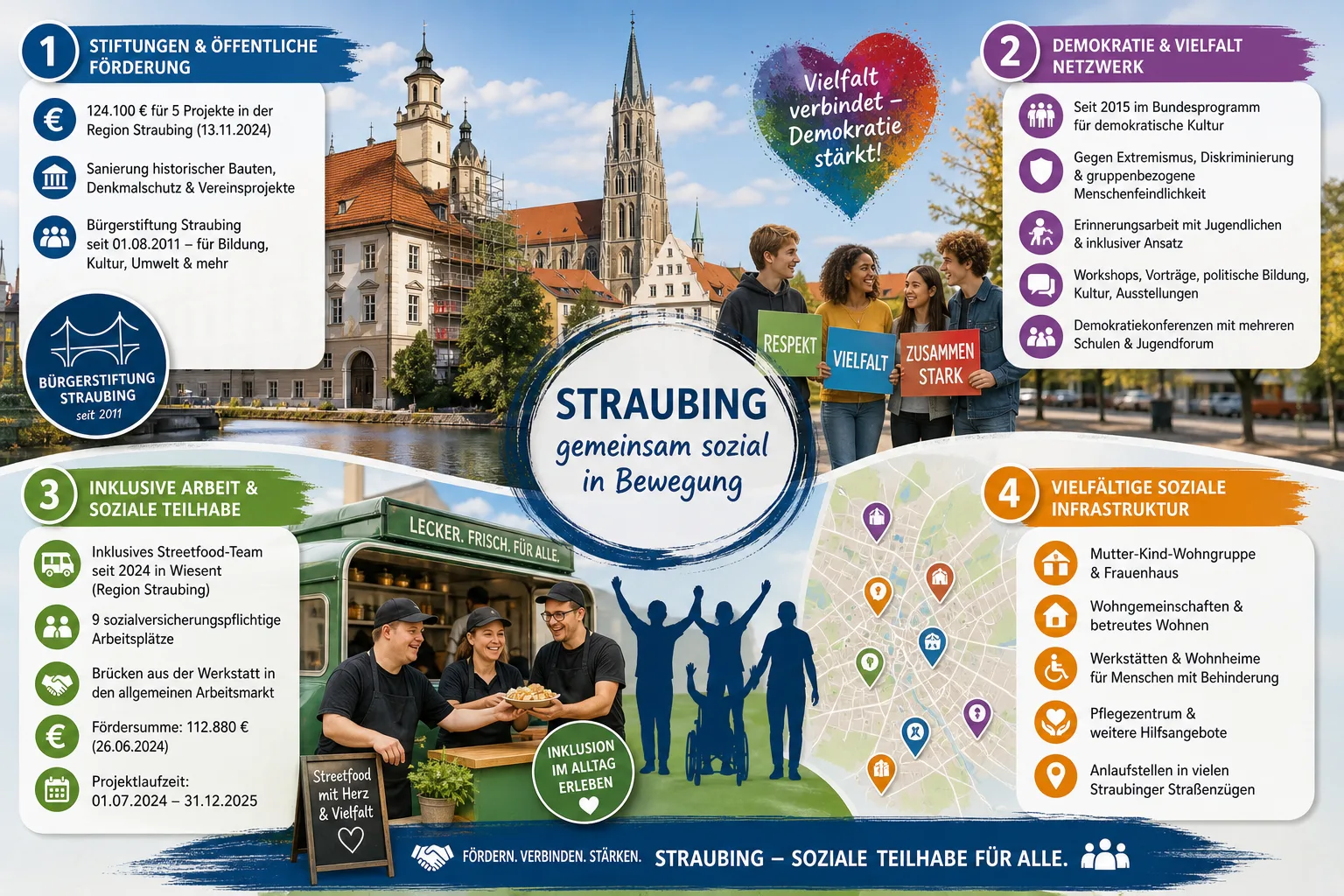
How does a city change when a single donation becomes a sustainable network—and an idea becomes a project that enables long-term participation? In Straubing, this transformation can especially be observed where people, associations, institutions, and the city itself join forces in the coming months and years: in cultural venues, educational spaces, youth work, counseling centers, and inclusive employment opportunities.
This overview brings together the most important fields of action, shows how funding, engagement, and infrastructure interact—and how residents and guests can concretely support Straubing in the future.
Public Funding: When Support Becomes Visible in the Future
Many social initiatives in Straubing depend on places being preserved, modernized, or made more accessible. When buildings are renovated, multipurpose rooms upgraded, or cultural venues enhanced, not only do “beautiful facades” emerge, but also usable spaces for encounters: for workshops, open meetups, learning opportunities, club life, and events.
In the next funding periods, projects in Straubing will typically be prioritized that:
- Enable community-oriented use (e.g., educational and cultural offerings, low-threshold meeting points).
- Improve accessibility (access points, sanitary facilities, guidance systems, safe pathways).
- Ensure sustainable use (energy measures, durable renovations, meaningful multiple uses).
What matters less is the individual measure and more the social effect: When a place is reliably available, providers can plan long-term—and individual actions become regular offerings that consistently reach children, youth, families, and seniors.
Community Foundation: Donations as the Engine of Urban Society
A proven principle for local impact is the foundation and donation model: Many small contributions can together make projects possible that otherwise would not start—such as additional learning and leisure activities, cultural formats, environmental actions, or support funds for acute hardship cases.
For the coming period, it is particularly effective when donations and endowments:
- Can be used for specific purposes (e.g., youth, education, inclusion, culture) or flexibly (wherever the need is greatest),
- Are coordinated with local partners (schools, associations, social organizations),
- Are linked to clear criteria (target group, duration, expected impact, transparency about use of funds).
Those who want to support Straubing can have a particularly strong impact in the future by not only giving once, but in a planned way—such as through regular donations or contributions to specific project budgets.
Democracy & Diversity: Educational Work That Reaches Everyday Life
In the coming years, municipal democracy and prevention work will likely continue to gain importance: because social debates are becoming rougher, because online disinformation is increasing, and because young people need reliable spaces to resolve conflicts fairly.
Effective formats that will be particularly in demand in Straubing in the future are:
- Workshops on discrimination, civil courage, and media literacy (e.g., recognizing disinformation, dealing with hate online).
- School- and youth-spanning dialogue formats in which young people set their own topics and initiate projects.
- Cultural and remembrance work that connects history and the present—e.g., through exhibitions, readings, or theater projects.
The benefit is concrete: Those who learn early to change perspectives, respect boundaries, and negotiate conflicts strengthen togetherness—not abstractly, but in club life, in everyday training, in the neighborhood, and in digital spaces.
Inclusive Work: Participation Through Visible Jobs in Public Spaces
Inclusion becomes especially tangible when it is experienced as normal cooperation—in teams, in customer contact, in responsibility for quality and processes. For the coming years, inclusive employment models that employ people with and without disabilities together are therefore important in many regions (and typically also in the Straubing area).
Success factors for new inclusive job opportunities are:
- Social security-contributing employment with fair standards, clear roles, and development opportunities.
- Support & qualification (e.g., job coaching, on-the-job guidance, further training).
- Visibility: Offers that take place in everyday life (e.g., gastronomy, service, logistics, culture) change perceptions.
Whether it’s inclusive catering, a mobile food stand, or a service project: What matters is that customers are not “buying pity,” but receiving a good product—and thus naturally supporting participation.
Social Infrastructure: Contact Points That Will Provide Stability in the Future
A city remains socially strong when help is not only visible in moments of crisis, but is permanently accessible. For Straubing, this will mean above all: reliable counseling and protection services, stable housing and care arrangements, and low-threshold meeting places.
For the coming years, it is particularly relevant that social infrastructure:
- Is easy to find (clear signposting, understandable web information, central contact points),
- Is accessible with few barriers (spatially, linguistically, digitally),
- Works in a networked way (transitions between counseling, care, education, work).
This creates a network that supports people in different life situations: families who need support, young people seeking orientation, victims of violence, people with disabilities, seniors, or newcomers who want to connect.
How Residents and Guests Can Help Shape Straubing in the Future
Social projects thrive on people getting involved—reliably, respectfully, and with a realistic view of their own time frame. These approaches are particularly effective in practice:
- Volunteering with a clear role: e.g., supporting events, learning mentorship, helping in the background (organization, technology, public relations)—ideally with an introduction and fixed contacts.
- Donations with impact: preferably to transparent local structures (e.g., foundations, recognized organizations) that clearly document goals, selection criteria, and use of funds.
- Participation strengthens offerings: Those who attend discussion evenings, exhibitions, concerts, or inclusive cultural formats make visible what is needed—and help ensure that formats continue.
- Everyday actions: respectful interaction, small acts of civil courage, conscious support of inclusive offers—these shape city culture every day.
This way, a single decision (time, donation, participation, recommendation) can create a chain: more stability for providers, higher quality in offerings, and ultimately more trust in a city that doesn’t lose sight of anyone.
Outlook: Straubing as a Vibrant Social Space—What Matters Next
For the future, it will be crucial that Straubing does not see social projects as isolated measures, but as interconnected urban development: preserving and opening spaces, strengthening education and democracy work, expanding inclusion in working life, and making help reliably accessible.
If this succeeds, Straubing will continue to be a place in the coming years where cohesion is not just claimed, but practically organized—in projects that are visible, and in structures that reliably function in the background.