Discovering Industrial Culture & Architecture in Straubing
Industrial Culture & Architecture in Straubing: Preview of Future Discoveries Along City Square, Danube, and Knowledge Sites
This article looks exclusively ahead: It shows how you could experience Straubing's industrial culture and architecture in upcoming visits, seasonal programs, and your own tours—with a focus on planning, orientation, and responsible exploration.
What to Expect in the Coming Years
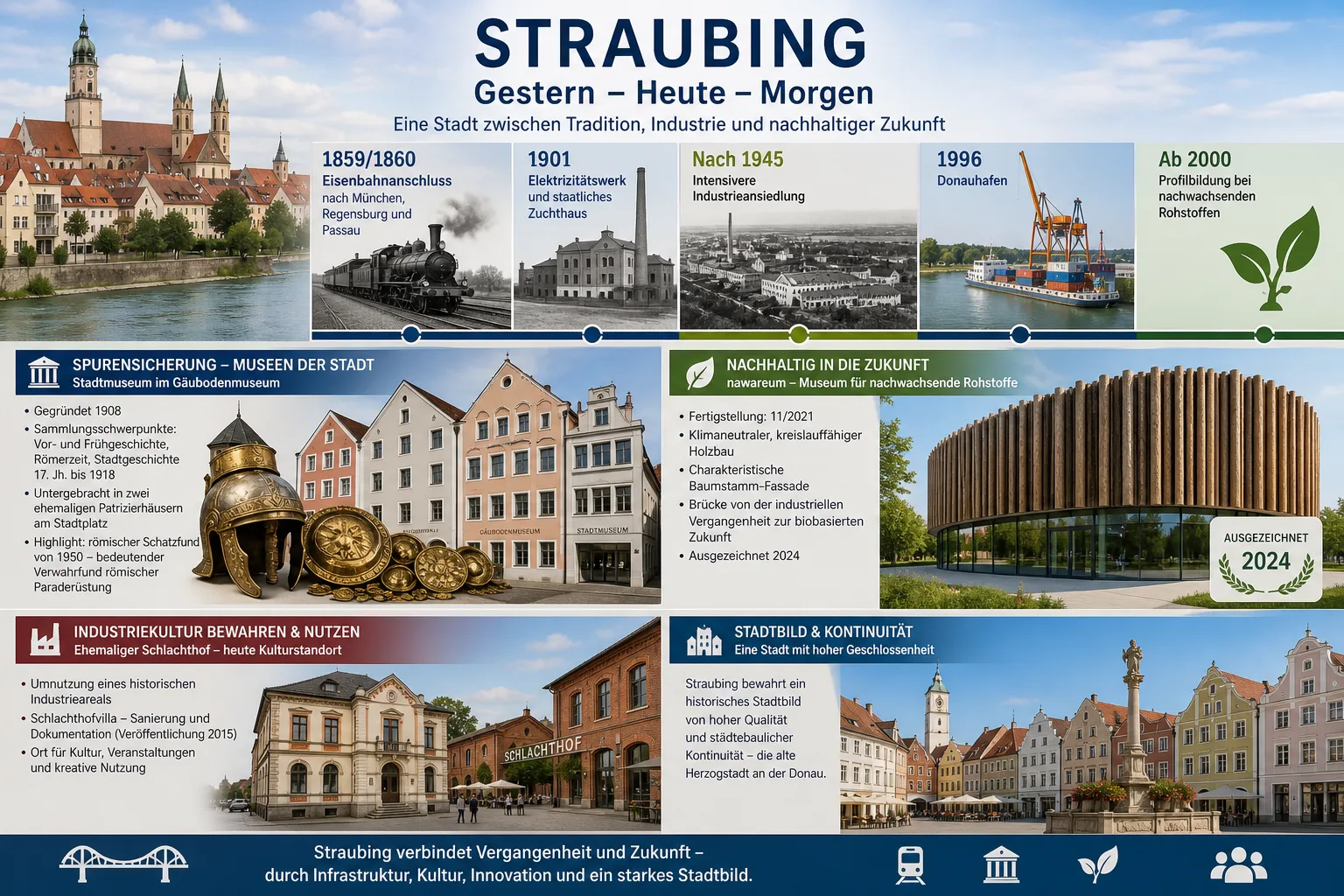
When you explore Straubing in the future (e.g., in upcoming travel seasons), you will most likely perceive industrial culture not as a "single monument," but as an interplay of several layers: urban spaces, transport axes, building shells, repurposing, and educational sites. This very mix makes future tours interesting, because you can not only see changes in the cityscape but also understand them as an ongoing process.
- Learning to read architecture: Materials, proportions, and traces of repurposing as clues to former and future functions.
- Infrastructure as a narrative thread: Pathways between the center, waterfront, and workplaces as a guiding line for your route.
- Knowledge & mediation sites: Museums and exhibitions as anchor points to contextualize observations.
- Sustainable future visions: Timber construction, circular thinking, and resource-efficient redesign as topics that could shape future programs.
How to Plan Your Future Tour (Without Stress, but With Substance)
1) Set a Time Frame: Short, Medium, In-Depth
- 60–90 minutes: a compact city walk focusing on facades, squares, and a few striking contrasts.
- Half a day: additionally a mediation site (exhibition/museum) plus a walk along the Danube.
- Full day: combine two thematic focuses (e.g., repurposing + sustainable building) and plan breaks.
2) Choose a Guiding Question
So your visit doesn't stop at "pretty sights," a guiding question helps. Three proven options:
- "What was repurposed here—and why in this way?" (Focus on interventions, material changes, access)
- "Which routes connect work, commerce, and living?" (Focus on city structure, axes, transitions)
- "How is sustainability really shown in architecture?" (Focus on construction, lifespan, deconstructability)
3) Check in Advance: Opening Hours, Routes, Rules
For future visits, it's worth checking the official information pages of the city, museums, and organizers shortly before arrival. This way, you avoid closed buildings, changed admissions, or routes that are not practical due to construction work.
Possible Route for Future Discoveries (as a Flexibly Combinable Modular Principle)
The following route is deliberately formulated as a modular system: You can rearrange the modules in the future according to your interests, seasonal program, and accessibility. The exact order is less important than the alternation between historic density, infrastructural transitions, and contemporary future topics.
Module A: Urban Space & Facades as an "Archive"
At the start of a future tour, a focused look at street spaces, rooflines, ground floor zones, and material changes is worthwhile. Pay particular attention to:
- Differences between representative fronts and functional backs
- Traces of later adaptations (new openings, reinforced beams, visible installations)
- Transitions from commercial to service use, often visible in shop windows, entrances, and lighting
Module B: Proximity to the Danube as an Infrastructure Narrative
If you include routes toward the Danube in the future, you can grasp the topic of "city and logistics" without numbers: Widths of streets, sightlines, noise patterns, and transitions between recreational and transport spaces often tell more than pure chronology.
Module C: Repurposing & Culture in Formerly Functional Shells
Many future industrial culture programs focus on how robust buildings are opened up for new uses: exhibitions, rehearsal rooms, meeting spaces, or temporary formats. Pay attention to the quality of the repurposing:
- Respect for the substance: Are supporting structures still visible?
- New accessibility: Are routes understandable and safe?
- Clear additions: Does the new appear as a readable layer rather than a disguise?
Module D: Future Topic "Building with Renewable Raw Materials"
For future visits, it can be very rewarding to plan a stop that conveys the topic of renewable raw materials or bioeconomy from an architectural and technical perspective. This way, industrial culture is not only backward-looking, but becomes a learning field for the coming decades—through construction, material cycles, and the question of how buildings remain adaptable in the long term.
Practical Tips for Future Visits: Safe, Respectful, Rewarding
- Safety first: Do not enter cordoned-off areas or construction sites in the future. Industrial culture can also be "read" well from public paths.
- Photograph with discretion: For interiors and events, check the respective rules; respect privacy rights.
- Plan for accessibility: Find out in advance about step-free access, elevators, and restroom facilities so the tour remains truly relaxed.
- Weather and shade logic: Especially along open waterfront and square spaces, the experience can change greatly depending on the season—adjust your future route accordingly if needed.
Transparency: What This Outlook Can (and Cannot) Provide
This text is deliberately written as a future-oriented planning aid. It does not describe completed historical processes, but shows how you can explore industrial culture and architecture in a structured way during future visits. For binding details (programs, opening hours, access, rules), the respective official information pages are authoritative.