Civic Participation and Urban Development in Straubing
Civic Participation & Urban Development in Straubing: How a City Grows Together
What could Straubing look like in the coming years if many voices are truly heard—from young people in the neighborhoods to businesses in the city center? Civic participation is not just a formal step in a process, but (when done well) can be lived democracy and a practical driver for modern urban development.
This article explains which participation pathways typically play a role in Germany for urban development and construction projects, what goals are behind them, and how people in Straubing can effectively get involved in the future.
Civic Participation: Legal Framework and Practical Significance
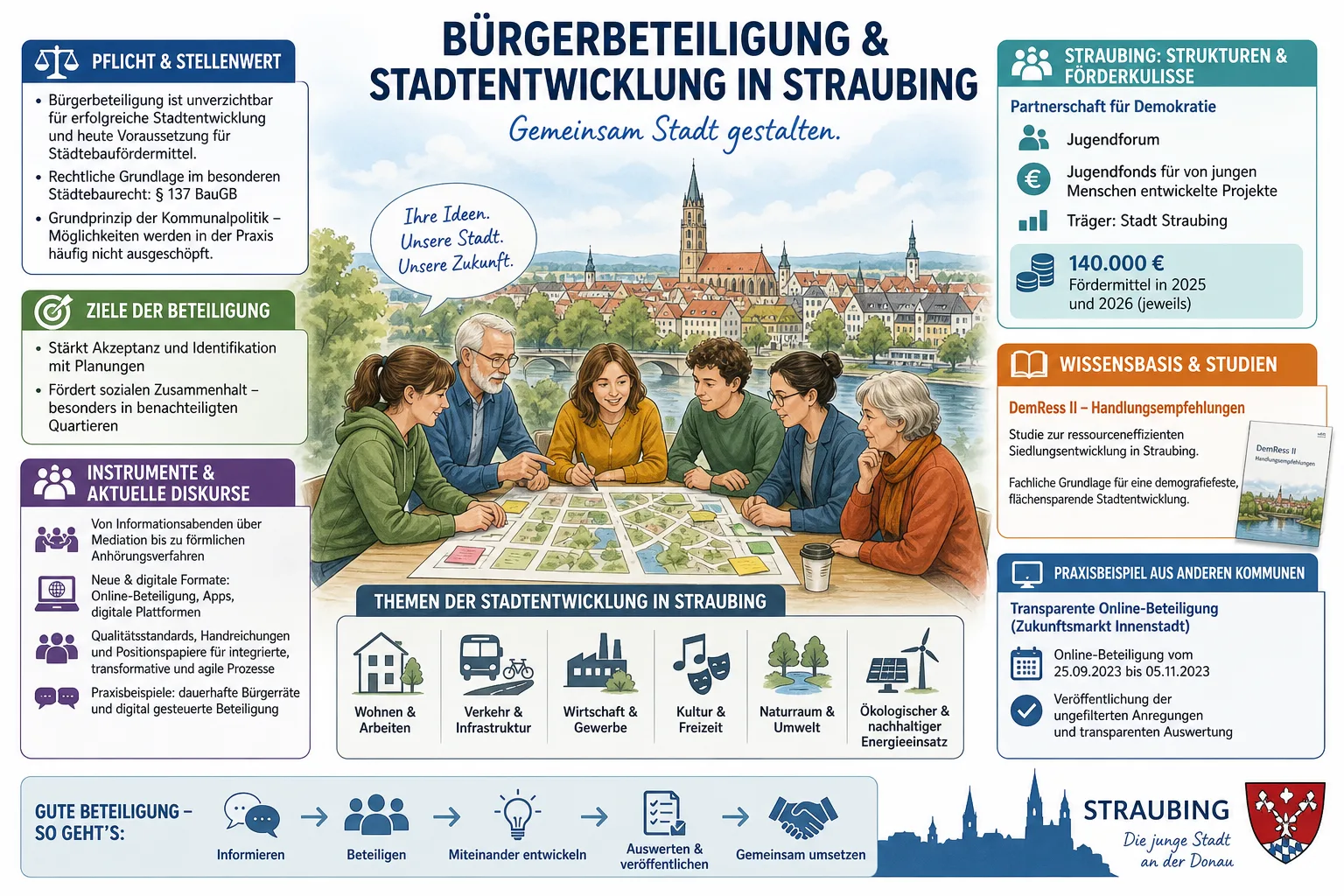
In Germany, participation in urban development is closely linked to building and planning law. For land-use planning (e.g., land use plan, development plan), the Building Code (BauGB) expressly provides for participation steps. The goal is to inform those affected at an early stage and give them the opportunity to provide comments and objections, which are then taken into account in the weighing process.
For Straubing, this means in perspective: When new residential areas, redesigns in public spaces, traffic solutions, or the development of neighborhoods are pending, participation formats can help translate everyday knowledge into planning. Participation thus becomes an opportunity to recognize conflicts early, make alternatives visible, and make decisions more comprehensible.
Goals of Civic Participation: More Than Approval
Participation is especially valuable when it not only informs but enables real feedback. Typical goals that Straubing can achieve in future urban development processes are:
- Acceptance and Identification: Those who understand early on what is being planned and why, and can contribute their own perspectives, are more likely to experience changes as a joint project.
- Better Decisions Through Local Knowledge: Residents often know routes, conflict points, places to stay, and usage times more precisely than plans can depict.
- Transparency and Trust: When it becomes visible which comments have been received and how they are handled, the comprehensibility of political and professional decisions increases.
- Social Cohesion: Well-moderated formats can enable dialogue—especially where interests diverge (e.g., traffic, noise, land use).
Instruments of Participation: From Formal to Dialogue-Oriented
Different formats can be useful for future projects. The right mix depends on the topic, timeframe, conflict potential, and the question of how open the decision still is.
Formal Participation in Planning Procedures
- Early Public Participation: An initial insight into goals, options, and possible impacts—before details are set.
- Public Display and Comments: Citizens can submit comments in writing or digitally; these inputs are included in the weighing process.
Dialogue and Workshop Formats (Supplementary)
- Information Evenings and Consultation Hours: For questions, classification, and direct feedback to planning and administration.
- Workshops, Future Workshops, City Walks: For concrete local knowledge, comparison of options, and jointly developed guiding principles.
- Moderated Round Tables/Mediation: When usage conflicts are foreseeable and viable compromises need to be developed.
Digital Participation
Digital formats can play a greater role in the future because they allow contributions independent of time and place (e.g., map feedback, short online surveys, commentable drafts). What is crucial is a clear evaluation: Who can participate when, which questions are up for decision, and how are results published?
Which Topics in Straubing Are Particularly Suitable for Participation
Urban development affects many areas of life that may repeatedly come up on the agenda in Straubing in the coming years. Participation is especially helpful when it starts early and addresses concrete questions, for example:
- Housing & Land: How can land-saving development succeed, how are existing neighborhoods strengthened, and where is densification sensible and compatible?
- Transport & Safety: Which routes (on foot, by bike, public transport, car) need better connections, where do school routes need to be secured, where can conflict points be defused?
- Public Space & Green Areas: Which squares and green spaces should gain in quality of stay, how are uses (sports, relaxation, events) balanced?
- Economy & Commerce: How do locations develop further without unnecessarily burdening the environment and land, and how can mixed uses be designed in a way that is compatible with the city?
- Climate Adaptation: Where should heat islands be reduced, how are shade, water, and greenery integrated into planning and redevelopment?
Expert Knowledge as a Basis: Resource-Efficient Settlement Development
For future decisions, a reliable knowledge base is important: Data on demographics, land consumption, infrastructure costs, traffic, and environmental impacts help to realistically compare options. Studies on resource-efficient settlement development (such as approaches discussed under the keyword "DemRess" in the professional debate) can provide methodological guidelines for this—for example, on the question of how growth can be organized in a land-saving and long-term sustainable way.
This perspective becomes particularly effective when it is presented in an understandable way in participation formats: Then everyday knowledge from the urban society and planning criteria (e.g., accessibility, open space, follow-up costs) can be transparently combined.
Promoting Engagement: Participation Structures and Democracy Promotion
In addition to planning law procedures, Straubing can also strengthen engagement in the future through democracy promotion programs and local participation structures—for example, through spaces for initiatives, project funding, or formats that specifically address young people. In such structures, for example, youth formats can emerge in which topics are collected, prioritized, and translated into concrete projects.
Important for credibility and impact is a clear process logic: Who decides what? What budgets are possible? What criteria apply? And how are results and implementation statuses publicly documented?
How Residents of Straubing Can Help Shape the Future
Effective participation usually begins with good preparation. For upcoming processes, these steps help:
- Get informed early: Pay attention to announcements about planning procedures, neighborhood processes, or dialogue events (e.g., in the city gazette, on the city's website, or through public notices).
- Bring concrete observations: Note places, times, and examples (e.g., "school route in the morning," "noise in the evening," "missing crossing"). Concrete comments are especially helpful for weighing decisions.
- Formulate suggestions as alternatives: Not just "against" or "for," but "Alternative A/B with justification"—this increases the chance that comments will be incorporated into drafts.
- Demand transparency—objectively and firmly: Ask how feedback is evaluated, where results are published, and which points (and why) are not adopted.
- Bundle with others: Joint comments from neighborhoods, clubs, or initiatives can better describe impacts and clarify priorities.
Outlook: Urban Development as a Learning Process
In the coming years, participation and urban development are likely to become even more intertwined: Digital formats will complement in-person offerings, target group approaches will become more differentiated, and the expectation for transparent documentation will increase. Straubing can benefit if participation starts early, defines understandable decision-making spaces, and reliably feeds back results—so that participation does not end with a conversation, but can be found in comprehensible steps in the cityscape.