
Bogen
Bogenberg 10, 94327 Bogen, Deutschland
Parish and Pilgrimage Church of the Holy Cross | Photos & History
The Parish and Pilgrimage Church of the Holy Cross, also known on the Bogenberg under the patronage of the Assumption of Mary, is one of the most impressive religious and cultural historical sites in Lower Bavaria. High above the town of Bogen, the Bogenberg rises as a visible harbinger of the Bavarian Forest. At its summit, an extraordinary landscape combines with a centuries-old pilgrimage tradition, a late Gothic church, and a miraculous image that is among the most famous Marian images in the region. Therefore, those searching for photos of the Parish and Pilgrimage Church of the Holy Cross will find far more than a single attraction: visible are a distinctive church tower, a historic church building, the surrounding summit plateau, the Stations of the Cross, the district museum, and the wide views into the Danube plain.
The Bogenberg is considered one of the oldest living Marian pilgrimage sites in Bavaria. Its significance is based on a combination of traditional legends, documented pilgrimage history, and an actively practiced religious tradition to this day. The church serves as a parish church, pilgrimage destination, and cultural monument at the same time. On certain days, groups of pilgrims walk up the mountain, while other visitors get to know the church as part of an excursion, a guided tour, or a visit to the historic surroundings. Particularly impressive is the contrast between the simple tranquility of the house of God and the large pilgrimage events that regularly fill the Bogenberg with life.
Parish and Pilgrimage Church of the Holy Cross on the Bogenberg
The official designation of the house of God refers to the two religious traditions that shape the Bogenberg: Holy Cross and the Assumption of Mary. In everyday life, the church is often referred to as the Pilgrimage Church Bogenberg or the Parish and Pilgrimage Church of the Assumption of Mary. The Parish and Pilgrimage Church of the Holy Cross you are looking for is located at Bogenberg 10 in 94327 Bogen. Its location on the summit plateau makes it a point of orientation even from a distance. The mountain rises prominently from the Danube plain and is also referred to as the Holy Mountain of Lower Bavaria due to its spiritual significance.
The current church building was completed in 1463. It belongs to the tradition of late Gothic hall churches in Bavaria and still preserves the special effect of a medieval sacred space. The building did not arise independently of the pilgrimage but is closely linked to its development. With the increasing number of pilgrims, a larger and more representative church building became necessary. The history of the Bogenberg goes back significantly further than the current building. From a local and private church of the Counts of Bogen, it developed into a significant Marian pilgrimage site in the 12th and 13th centuries.
The church stands in a historic ensemble, which includes not only the cemetery and the parish area but also other religious and cultural-historical stations. In the immediate vicinity are the Stations of the Cross, the Salvator Chapel, the Mount of Olives Chapel, and the Bogenberg District Museum. This allows for a well-rounded visit. Those who not only consider the interior but the entire Bogenberg will recognize that the church is the center of a developed sacred landscape. Paths, chapels, viewpoints, and historic buildings complement each other and make the mountain a versatile destination for culture enthusiasts, pilgrims, photographers, and families.
For visitors, it is important to distinguish between a private photo motif and a house of God. Exterior views can be particularly well captured from the ascent, from the summit area, and from various points around Bogen. In the interior, the dignity of the place, services, and the privacy of praying individuals should be respected. The most beautiful photos are often taken not only in sunny weather but also under changing lighting conditions, when the tower, roof surfaces, and landscape stand out clearly from one another. For a planned photographic shot inside, it is advisable to inquire with the parish office about the applicable rules beforehand.
Bogenberg History and Medieval Miraculous Image
The history of the Bogenberg is shaped by a legend according to which a stone Marian image was said to have been washed ashore against the current of the Danube in the year 1104. Count Aswin of Bogen is said to have brought the image to the mountain and placed it in his castle chapel. This narrative remains part of the self-understanding of the pilgrimage site to this day. It explains why the mountain is perceived as a special place of Marian veneration and why the miraculous image is at the center of the pilgrimage. The legend is religiously transmitted and should be distinguished from later documented evidence.
Documentary evidence allows us to trace the significance of the Bogenberg in the Middle Ages further. The mountain was referred to as the mountain of the Holy Mary. For the late 13th century, indulgence letters have been documented, indicating an already existing pilgrimage. In 1295, the construction of a larger church began. In 1298, the Bogenberg became a priory of the Benedictine monastery of Oberalteich. For centuries, the Benedictines cared for the parish and the pilgrimage. It was not until the dissolution of the monastery in 1803 that this long phase of Benedictine pilgrimage pastoral care came to an end.
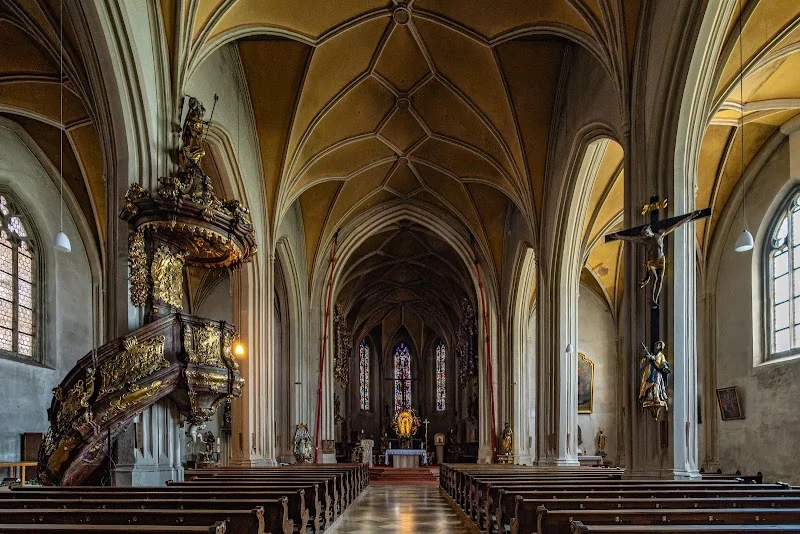
The current church building was constructed in the 15th century and completed in 1463. Its late Gothic form still conveys an impression of the significance that the pilgrimage site held for the people of that time. The furnishings have been changed several times over the centuries. Among other things, the pulpit from around 1735, six oratories in the choir, the organ case, and several altar paintings have been preserved. Between 1870 and 1881, the furnishings were largely altered to emphasize the Gothic character of the church space more strongly.
Particularly unusual is the miraculous image of the Mother of God in Hope. The parish describes a Romanesque stone figure as one of the few surviving testimonies of Romanesque folk art. In addition, a sandstone Madonna from around 1400 is mentioned, which shows an extraordinary motif: Mary is depicted as a pregnant Mother of God. Under her heart is an opening through which the infant Jesus is visible. This motif is rare in European art history and gives the Bogenberg miraculous image its special significance. Visitors should take their time to contemplate, as the religious message does not always become clear at first glance.
After World War II, the pilgrimage experienced a new bloom. Between 1953 and 1961, among other things, the high altar and the miraculous altar were redesigned. In 1954, the miraculous image was moved from the high altar to its own altar at the entrance to the choir. There it is located in a shrine with rays and silver-plated angels. The changes show that the church is not only a historical object but a living place whose furnishings have been repeatedly adapted to liturgical and pastoral needs.
Pilgrimage Bogenberg and Holzkirchen Pentecost Pilgrimage
The Bogenberg is known not only for its architecture but especially for its pilgrimage, which is still maintained today. More than 60 pilgrimages take place annually to the mountain. Pilgrim groups come from different places, at various times, and with their own traditions. Some pilgrimages combine a long walk with a service, while others are focused on a specific intention. As a result, the atmosphere of the Bogenberg changes depending on the season and event: On ordinary days, the place feels calm and contemplative, while large pilgrimages are characterized by singing, prayer, community, and visible movement.
The most famous pilgrimage is the Holzkirchen Pentecost Pilgrimage. It dates back to a vow from the late 15th century. According to tradition, the bark beetle threatened the forests at that time and thus the livelihood of the population. The people of Holzkirchen vowed to bring a candle for Marian veneration every year when the danger passed. Since then, the tradition has been continued. The pilgrims walk the path on foot and reach the Bogenberg on Pentecost weekend.
The special symbol of this pilgrimage is the so-called long pole. This is a spruce trunk about 13 meters long, which is wrapped in wax and carried upright to the mountain by several strong bearers. The candle is not comparable to a usual small church candle but is an impressive communal offering. Its size makes the physical effort visible and gives the entrance to the church a special tension. After arrival, the candle is placed in the pilgrimage church and traditionally remains there for an extended period.
The Holzkirchen Pentecost Pilgrimage is therefore also interesting for visitors who are interested in regional customs, folk piety, and living cultural history. Those who want to experience the event should pay attention to the current information from the city of Bogen and the parish, as specific processes, times, and organizational details may change. For photo opportunities, the ascent, the arrival of the pilgrims, and the moments around the placement of the candle are particularly suitable. At the same time, it should be noted that the pilgrimage is primarily a religious vow and not a purely tourist event.
Other regular offerings include the Fatima celebration with a candlelight procession on the 13th day of the month. Additionally, peace pilgrimages, flood pilgrimages, and numerous local pilgrimages take place. The Bogenberg thus remains a destination for religious groups throughout the year. The pilgrimages demonstrate how historical traditions can adapt to modern times without losing their core. Those who visit the Bogenberg outside of major events can experience the tranquility of the place while also imagining how many generations have walked the same path.
Church Space, Photos, and Special Attractions
Photos of the Parish and Pilgrimage Church of the Holy Cross often show the prominently visible tower, the location on the mountain, and the late Gothic architecture. The tower is a defining element of the silhouette and makes the church recognizable even from the Danube plain. For exterior shots, the surroundings of the Bogenberg are suitable, as different perspectives can be combined there. From the ascent, the church appears as the destination of the path, while from the summit area, the building parts appear more compact and monumental. Depending on the season, the vegetation changes the effect of the images: In spring and summer, the building stands out against lush green tones, while autumn and winter emphasize the contours of the tower and roof more strongly.
Inside, visitors should pay attention to details that are often overlooked in photographs. The late Gothic character of the church space, the oratories in the choir, the pulpit, and the various altars tell of the changes that the house of God has undergone over centuries. The miraculous image is interesting not only because of its age but also because of its unusual depiction. Votive tablets and signs of Marian veneration make it visible that people connect their personal concerns, gratitude, and hopes with this place.
The church should not be viewed in isolation. Opposite is the Bogenberg District Museum in the former parish barn. The museum deals with the history of the Bogenberg, the pilgrimage, and other regional topics. A combination of church visit and museum tour is particularly sensible because the exhibition conveys historical backgrounds that are only partially recognizable in the church space itself. The museum is open seasonally; according to published information, opening hours are from April to October, as well as additional dates around the Bogenberg Christmas market. Before visiting, the current opening hours should be checked.
The historic environment also includes the Salvator Chapel below the pilgrimage church. Its origin is associated with an event from the year 1413, during which a host is said to have fallen to the ground at this spot. Initially, a wooden chapel was built, later a Gothic round building. Together with the pilgrimage church, the Stations of the Cross, and other stations, a religious landscape is created that makes the Bogenberg a special destination for cultural-historical walks.
Photographers will also find motifs outside the church building on the Bogenberg. The mountain offers views over the Danube plain and has a special fauna and flora due to its geological and climatic conditions. Steep slopes, dry areas, strong sunlight, and nutrient-poor soils have created a unique landscape. Information boards lead to topics from nature, culture, and history. Therefore, those who photograph can combine a visit to the church with landscape shots, architectural details, and images of the historic path.
Directions, Parking, and Visit in Bogen
The Parish and Pilgrimage Church of the Holy Cross is located at Bogenberg 10 in 94327 Bogen. The Bogenberg is located above the town and is accessible both by car and on foot. The exact route depends on the starting point and current traffic situation. For visitors arriving by car, it is advisable to use the destination Bogenberg and the local signage. During large pilgrimages, paths may be more frequented. Visitors should plan more time and pay attention to the organizers' notices.
There are designated parking options around the church. A specific number of parking spaces or a permanently valid parking designation is not reliably indicated in publicly accessible information. Therefore, it should not be assumed that unlimited parking spaces are available directly next to the church during every larger visit. For people with limited mobility, travel groups, and visitors with special needs, it is advisable to make a prior inquiry with the parish office. Bus groups should also coordinate access and disembarkation in advance.
Those who want to experience the Bogenberg more intensively can choose to walk up from Bogen. The historic path leads up via the Stations of the Cross and makes the visit a small pilgrimage hike. The perspective on the church changes step by step. The path combines physical movement with nature and cultural experience and is particularly suitable for visitors who want to understand the significance of the place rather than just quickly view a building. Sturdy footwear is recommended depending on the weather and path conditions.
For planning a visit, services, pilgrimage dates, tours, and possible restrictions should also be taken into account. A church is not an ordinary museum with an identical process at all times. During services, processions, or religious events, access may be restricted or special rules may apply. The Bogenberg parish office can be reached at the phone number 09422 1546. The city of Bogen also provides information about attractions, pilgrimages, and events at the Bogenberg.
The opening hours of the parish office should not be equated with a general opening time of the church. Those wishing to book a tour, register a group, or clarify special questions should contact the parish office directly. According to published information, the parish office is open on Tuesdays from 9 to 11 a.m., Wednesdays from 3 to 5 p.m., and Thursdays from 3 to 5 p.m. These times may change. For reliable planning, the official website of the parish or direct contact should therefore be used.
Church Tour, District Museum, and Excursion Destinations
A church tour offers the opportunity to get to know the Bogenberg not only independently but with professional guidance. Tours are offered for groups of ten or more. A pure church tour lasts about 30 minutes. In addition, tours can be combined with the district museum and a walk around the Bogenberg. This option is particularly suitable if a group wants to view the religious history, the historic church building, and the landscape together.
Registration should be done at least two weeks before the desired date. For a tour without a museum visit, the parish office is responsible. If the district museum is to be included, registration can be done through the museum. The parish points out that tours are organized for a voluntary donation or, depending on the offer, for a fee. Visitors should indicate when registering how large the group is, whether a museum visit is desired, and whether special requirements need to be considered.
The Bogenberg District Museum is located in the former parish barn opposite the church. It explains the development of the Bogenberg and provides background information on the pilgrimage. An audio guide can be used for individual tours. This allows for flexible visit arrangements: First, the church can be visited, followed by the museum, before a walk over the summit plateau or along the historic stations. The combination is also interesting for families and school groups because it connects religious history, regional culture, and nature observation.
The Bogenberg is also suitable as a starting point for further activities in and around Bogen. The town is located on the Danube and at the transition to the Bavarian Forest. Walks, regional excursions, and bike tours can be combined with a visit to the pilgrimage church. Those who reach the mountain via the Stations of the Cross experience the church as the destination of a path. Those arriving by car can extend their stay with a tour and a museum visit. This turns a short photo stop into a varied half or full day.
The best time to visit depends on personal interest. For quiet interior shots and a peaceful visit, times outside of large pilgrimages are suitable. Those who want to get to know the living tradition should inform themselves about Pentecost, the Holzkirchen pilgrimage, or other announced dates. For landscape photography, early morning and late afternoon hours are often particularly atmospheric. Regardless of the date, it applies: The Bogenberg is a religious place. Consideration, appropriate clothing, and respectful behavior contribute to ensuring that both pilgrims and tourist visitors experience their stay as pleasant.
Why a visit to the church in Bogen is worthwhile
The Parish and Pilgrimage Church of the Holy Cross on the Bogenberg unites several levels that can be experienced simultaneously during a visit. It is a late Gothic church building, an active pilgrimage site, a parish church, a historical monument, and a destination for nature and culture enthusiasts. Its effect arises not only from individual works of art or the age of the building but from the interplay of location, history, and religious use.
For those interested in history, the Bogenberg offers a development that ranges from the medieval church of the Counts of Bogen through the pilgrimage of the 12th and 13th centuries to the late Gothic building of 1463. The connection to the Oberalteich monastery, the changes in furnishings, and the revival of the pilgrimage after World War II make the site a vivid example of the long-term development of a Bavarian pilgrimage center.
For religious visitors, the miraculous image, the services, the processions, and the pilgrimage paths are at the center. The image of the Mother of God in Hope possesses a strong symbolic message and has been venerated for centuries. The large pilgrimages show that the tradition lives on not only in books or museum objects but is carried by people. Especially the long candle from Holzkirchen makes the power of communal religious customs visible.
For photographers, the Bogenberg is interesting due to its distinctive silhouette, historic architecture, and landscape. The search for photos of the Parish and Pilgrimage Church of the Holy Cross can therefore lead to various motifs: exterior view, church tower, late Gothic interior, miraculous image, votive tablets, Stations of the Cross, chapels, museum, and view. Each perspective tells a different part of the story. Those who capture not only the building but also paths and surroundings convey the character of the entire pilgrimage site particularly authentically.
For excursionists, the Bogenberg combines education, movement, and relaxation. A short tour can be extended by a church visit. A guided tour provides additional information. The museum complements sacred art with historical contexts. The Stations of the Cross and the paths on the mountain turn the stay into a walk. Thus, the place is suitable for individual travelers, families, groups, and pilgrims alike.
The Parish and Pilgrimage Church of the Holy Cross is therefore not a destination that one visits only once for a single reason. Depending on the occasion, the church can be experienced as a photo motif, historic building, religious place, starting point for a hike, or part of a cultural day trip. This multifaceted nature explains why the Bogenberg has attracted people for centuries and continues to be one of the significant Marian pilgrimage sites in Bavaria.
Sources:
- City of Bogen - Catholic Parish and Pilgrimage Church Bogenberg
- City of Bogen - Pilgrimages to the Bogenberg
- City of Bogen - Pentecost Candle Pilgrimage
- Parish Bogenberg - Official Website
- Parish Bogenberg - Pilgrimages and History
- Parish Bogenberg - Church Tours
- Tourism Association East Bavaria - Pilgrimage Church on the Bogenberg
- Diocese of Regensburg - Pilgrimage Sites in the Diocese
Mehr anzeigenWeniger anzeigen
Parish and Pilgrimage Church of the Holy Cross | Photos & History
The Parish and Pilgrimage Church of the Holy Cross, also known on the Bogenberg under the patronage of the Assumption of Mary, is one of the most impressive religious and cultural historical sites in Lower Bavaria. High above the town of Bogen, the Bogenberg rises as a visible harbinger of the Bavarian Forest. At its summit, an extraordinary landscape combines with a centuries-old pilgrimage tradition, a late Gothic church, and a miraculous image that is among the most famous Marian images in the region. Therefore, those searching for photos of the Parish and Pilgrimage Church of the Holy Cross will find far more than a single attraction: visible are a distinctive church tower, a historic church building, the surrounding summit plateau, the Stations of the Cross, the district museum, and the wide views into the Danube plain.
The Bogenberg is considered one of the oldest living Marian pilgrimage sites in Bavaria. Its significance is based on a combination of traditional legends, documented pilgrimage history, and an actively practiced religious tradition to this day. The church serves as a parish church, pilgrimage destination, and cultural monument at the same time. On certain days, groups of pilgrims walk up the mountain, while other visitors get to know the church as part of an excursion, a guided tour, or a visit to the historic surroundings. Particularly impressive is the contrast between the simple tranquility of the house of God and the large pilgrimage events that regularly fill the Bogenberg with life.
Parish and Pilgrimage Church of the Holy Cross on the Bogenberg
The official designation of the house of God refers to the two religious traditions that shape the Bogenberg: Holy Cross and the Assumption of Mary. In everyday life, the church is often referred to as the Pilgrimage Church Bogenberg or the Parish and Pilgrimage Church of the Assumption of Mary. The Parish and Pilgrimage Church of the Holy Cross you are looking for is located at Bogenberg 10 in 94327 Bogen. Its location on the summit plateau makes it a point of orientation even from a distance. The mountain rises prominently from the Danube plain and is also referred to as the Holy Mountain of Lower Bavaria due to its spiritual significance.
The current church building was completed in 1463. It belongs to the tradition of late Gothic hall churches in Bavaria and still preserves the special effect of a medieval sacred space. The building did not arise independently of the pilgrimage but is closely linked to its development. With the increasing number of pilgrims, a larger and more representative church building became necessary. The history of the Bogenberg goes back significantly further than the current building. From a local and private church of the Counts of Bogen, it developed into a significant Marian pilgrimage site in the 12th and 13th centuries.
The church stands in a historic ensemble, which includes not only the cemetery and the parish area but also other religious and cultural-historical stations. In the immediate vicinity are the Stations of the Cross, the Salvator Chapel, the Mount of Olives Chapel, and the Bogenberg District Museum. This allows for a well-rounded visit. Those who not only consider the interior but the entire Bogenberg will recognize that the church is the center of a developed sacred landscape. Paths, chapels, viewpoints, and historic buildings complement each other and make the mountain a versatile destination for culture enthusiasts, pilgrims, photographers, and families.
For visitors, it is important to distinguish between a private photo motif and a house of God. Exterior views can be particularly well captured from the ascent, from the summit area, and from various points around Bogen. In the interior, the dignity of the place, services, and the privacy of praying individuals should be respected. The most beautiful photos are often taken not only in sunny weather but also under changing lighting conditions, when the tower, roof surfaces, and landscape stand out clearly from one another. For a planned photographic shot inside, it is advisable to inquire with the parish office about the applicable rules beforehand.
Bogenberg History and Medieval Miraculous Image
The history of the Bogenberg is shaped by a legend according to which a stone Marian image was said to have been washed ashore against the current of the Danube in the year 1104. Count Aswin of Bogen is said to have brought the image to the mountain and placed it in his castle chapel. This narrative remains part of the self-understanding of the pilgrimage site to this day. It explains why the mountain is perceived as a special place of Marian veneration and why the miraculous image is at the center of the pilgrimage. The legend is religiously transmitted and should be distinguished from later documented evidence.
Documentary evidence allows us to trace the significance of the Bogenberg in the Middle Ages further. The mountain was referred to as the mountain of the Holy Mary. For the late 13th century, indulgence letters have been documented, indicating an already existing pilgrimage. In 1295, the construction of a larger church began. In 1298, the Bogenberg became a priory of the Benedictine monastery of Oberalteich. For centuries, the Benedictines cared for the parish and the pilgrimage. It was not until the dissolution of the monastery in 1803 that this long phase of Benedictine pilgrimage pastoral care came to an end.
The current church building was constructed in the 15th century and completed in 1463. Its late Gothic form still conveys an impression of the significance that the pilgrimage site held for the people of that time. The furnishings have been changed several times over the centuries. Among other things, the pulpit from around 1735, six oratories in the choir, the organ case, and several altar paintings have been preserved. Between 1870 and 1881, the furnishings were largely altered to emphasize the Gothic character of the church space more strongly.
Particularly unusual is the miraculous image of the Mother of God in Hope. The parish describes a Romanesque stone figure as one of the few surviving testimonies of Romanesque folk art. In addition, a sandstone Madonna from around 1400 is mentioned, which shows an extraordinary motif: Mary is depicted as a pregnant Mother of God. Under her heart is an opening through which the infant Jesus is visible. This motif is rare in European art history and gives the Bogenberg miraculous image its special significance. Visitors should take their time to contemplate, as the religious message does not always become clear at first glance.
After World War II, the pilgrimage experienced a new bloom. Between 1953 and 1961, among other things, the high altar and the miraculous altar were redesigned. In 1954, the miraculous image was moved from the high altar to its own altar at the entrance to the choir. There it is located in a shrine with rays and silver-plated angels. The changes show that the church is not only a historical object but a living place whose furnishings have been repeatedly adapted to liturgical and pastoral needs.
Pilgrimage Bogenberg and Holzkirchen Pentecost Pilgrimage
The Bogenberg is known not only for its architecture but especially for its pilgrimage, which is still maintained today. More than 60 pilgrimages take place annually to the mountain. Pilgrim groups come from different places, at various times, and with their own traditions. Some pilgrimages combine a long walk with a service, while others are focused on a specific intention. As a result, the atmosphere of the Bogenberg changes depending on the season and event: On ordinary days, the place feels calm and contemplative, while large pilgrimages are characterized by singing, prayer, community, and visible movement.
The most famous pilgrimage is the Holzkirchen Pentecost Pilgrimage. It dates back to a vow from the late 15th century. According to tradition, the bark beetle threatened the forests at that time and thus the livelihood of the population. The people of Holzkirchen vowed to bring a candle for Marian veneration every year when the danger passed. Since then, the tradition has been continued. The pilgrims walk the path on foot and reach the Bogenberg on Pentecost weekend.
The special symbol of this pilgrimage is the so-called long pole. This is a spruce trunk about 13 meters long, which is wrapped in wax and carried upright to the mountain by several strong bearers. The candle is not comparable to a usual small church candle but is an impressive communal offering. Its size makes the physical effort visible and gives the entrance to the church a special tension. After arrival, the candle is placed in the pilgrimage church and traditionally remains there for an extended period.
The Holzkirchen Pentecost Pilgrimage is therefore also interesting for visitors who are interested in regional customs, folk piety, and living cultural history. Those who want to experience the event should pay attention to the current information from the city of Bogen and the parish, as specific processes, times, and organizational details may change. For photo opportunities, the ascent, the arrival of the pilgrims, and the moments around the placement of the candle are particularly suitable. At the same time, it should be noted that the pilgrimage is primarily a religious vow and not a purely tourist event.
Other regular offerings include the Fatima celebration with a candlelight procession on the 13th day of the month. Additionally, peace pilgrimages, flood pilgrimages, and numerous local pilgrimages take place. The Bogenberg thus remains a destination for religious groups throughout the year. The pilgrimages demonstrate how historical traditions can adapt to modern times without losing their core. Those who visit the Bogenberg outside of major events can experience the tranquility of the place while also imagining how many generations have walked the same path.
Church Space, Photos, and Special Attractions
Photos of the Parish and Pilgrimage Church of the Holy Cross often show the prominently visible tower, the location on the mountain, and the late Gothic architecture. The tower is a defining element of the silhouette and makes the church recognizable even from the Danube plain. For exterior shots, the surroundings of the Bogenberg are suitable, as different perspectives can be combined there. From the ascent, the church appears as the destination of the path, while from the summit area, the building parts appear more compact and monumental. Depending on the season, the vegetation changes the effect of the images: In spring and summer, the building stands out against lush green tones, while autumn and winter emphasize the contours of the tower and roof more strongly.
Inside, visitors should pay attention to details that are often overlooked in photographs. The late Gothic character of the church space, the oratories in the choir, the pulpit, and the various altars tell of the changes that the house of God has undergone over centuries. The miraculous image is interesting not only because of its age but also because of its unusual depiction. Votive tablets and signs of Marian veneration make it visible that people connect their personal concerns, gratitude, and hopes with this place.
The church should not be viewed in isolation. Opposite is the Bogenberg District Museum in the former parish barn. The museum deals with the history of the Bogenberg, the pilgrimage, and other regional topics. A combination of church visit and museum tour is particularly sensible because the exhibition conveys historical backgrounds that are only partially recognizable in the church space itself. The museum is open seasonally; according to published information, opening hours are from April to October, as well as additional dates around the Bogenberg Christmas market. Before visiting, the current opening hours should be checked.
The historic environment also includes the Salvator Chapel below the pilgrimage church. Its origin is associated with an event from the year 1413, during which a host is said to have fallen to the ground at this spot. Initially, a wooden chapel was built, later a Gothic round building. Together with the pilgrimage church, the Stations of the Cross, and other stations, a religious landscape is created that makes the Bogenberg a special destination for cultural-historical walks.
Photographers will also find motifs outside the church building on the Bogenberg. The mountain offers views over the Danube plain and has a special fauna and flora due to its geological and climatic conditions. Steep slopes, dry areas, strong sunlight, and nutrient-poor soils have created a unique landscape. Information boards lead to topics from nature, culture, and history. Therefore, those who photograph can combine a visit to the church with landscape shots, architectural details, and images of the historic path.
Directions, Parking, and Visit in Bogen
The Parish and Pilgrimage Church of the Holy Cross is located at Bogenberg 10 in 94327 Bogen. The Bogenberg is located above the town and is accessible both by car and on foot. The exact route depends on the starting point and current traffic situation. For visitors arriving by car, it is advisable to use the destination Bogenberg and the local signage. During large pilgrimages, paths may be more frequented. Visitors should plan more time and pay attention to the organizers' notices.
There are designated parking options around the church. A specific number of parking spaces or a permanently valid parking designation is not reliably indicated in publicly accessible information. Therefore, it should not be assumed that unlimited parking spaces are available directly next to the church during every larger visit. For people with limited mobility, travel groups, and visitors with special needs, it is advisable to make a prior inquiry with the parish office. Bus groups should also coordinate access and disembarkation in advance.
Those who want to experience the Bogenberg more intensively can choose to walk up from Bogen. The historic path leads up via the Stations of the Cross and makes the visit a small pilgrimage hike. The perspective on the church changes step by step. The path combines physical movement with nature and cultural experience and is particularly suitable for visitors who want to understand the significance of the place rather than just quickly view a building. Sturdy footwear is recommended depending on the weather and path conditions.
For planning a visit, services, pilgrimage dates, tours, and possible restrictions should also be taken into account. A church is not an ordinary museum with an identical process at all times. During services, processions, or religious events, access may be restricted or special rules may apply. The Bogenberg parish office can be reached at the phone number 09422 1546. The city of Bogen also provides information about attractions, pilgrimages, and events at the Bogenberg.
The opening hours of the parish office should not be equated with a general opening time of the church. Those wishing to book a tour, register a group, or clarify special questions should contact the parish office directly. According to published information, the parish office is open on Tuesdays from 9 to 11 a.m., Wednesdays from 3 to 5 p.m., and Thursdays from 3 to 5 p.m. These times may change. For reliable planning, the official website of the parish or direct contact should therefore be used.
Church Tour, District Museum, and Excursion Destinations
A church tour offers the opportunity to get to know the Bogenberg not only independently but with professional guidance. Tours are offered for groups of ten or more. A pure church tour lasts about 30 minutes. In addition, tours can be combined with the district museum and a walk around the Bogenberg. This option is particularly suitable if a group wants to view the religious history, the historic church building, and the landscape together.
Registration should be done at least two weeks before the desired date. For a tour without a museum visit, the parish office is responsible. If the district museum is to be included, registration can be done through the museum. The parish points out that tours are organized for a voluntary donation or, depending on the offer, for a fee. Visitors should indicate when registering how large the group is, whether a museum visit is desired, and whether special requirements need to be considered.
The Bogenberg District Museum is located in the former parish barn opposite the church. It explains the development of the Bogenberg and provides background information on the pilgrimage. An audio guide can be used for individual tours. This allows for flexible visit arrangements: First, the church can be visited, followed by the museum, before a walk over the summit plateau or along the historic stations. The combination is also interesting for families and school groups because it connects religious history, regional culture, and nature observation.
The Bogenberg is also suitable as a starting point for further activities in and around Bogen. The town is located on the Danube and at the transition to the Bavarian Forest. Walks, regional excursions, and bike tours can be combined with a visit to the pilgrimage church. Those who reach the mountain via the Stations of the Cross experience the church as the destination of a path. Those arriving by car can extend their stay with a tour and a museum visit. This turns a short photo stop into a varied half or full day.
The best time to visit depends on personal interest. For quiet interior shots and a peaceful visit, times outside of large pilgrimages are suitable. Those who want to get to know the living tradition should inform themselves about Pentecost, the Holzkirchen pilgrimage, or other announced dates. For landscape photography, early morning and late afternoon hours are often particularly atmospheric. Regardless of the date, it applies: The Bogenberg is a religious place. Consideration, appropriate clothing, and respectful behavior contribute to ensuring that both pilgrims and tourist visitors experience their stay as pleasant.
Why a visit to the church in Bogen is worthwhile
The Parish and Pilgrimage Church of the Holy Cross on the Bogenberg unites several levels that can be experienced simultaneously during a visit. It is a late Gothic church building, an active pilgrimage site, a parish church, a historical monument, and a destination for nature and culture enthusiasts. Its effect arises not only from individual works of art or the age of the building but from the interplay of location, history, and religious use.
For those interested in history, the Bogenberg offers a development that ranges from the medieval church of the Counts of Bogen through the pilgrimage of the 12th and 13th centuries to the late Gothic building of 1463. The connection to the Oberalteich monastery, the changes in furnishings, and the revival of the pilgrimage after World War II make the site a vivid example of the long-term development of a Bavarian pilgrimage center.
For religious visitors, the miraculous image, the services, the processions, and the pilgrimage paths are at the center. The image of the Mother of God in Hope possesses a strong symbolic message and has been venerated for centuries. The large pilgrimages show that the tradition lives on not only in books or museum objects but is carried by people. Especially the long candle from Holzkirchen makes the power of communal religious customs visible.
For photographers, the Bogenberg is interesting due to its distinctive silhouette, historic architecture, and landscape. The search for photos of the Parish and Pilgrimage Church of the Holy Cross can therefore lead to various motifs: exterior view, church tower, late Gothic interior, miraculous image, votive tablets, Stations of the Cross, chapels, museum, and view. Each perspective tells a different part of the story. Those who capture not only the building but also paths and surroundings convey the character of the entire pilgrimage site particularly authentically.
For excursionists, the Bogenberg combines education, movement, and relaxation. A short tour can be extended by a church visit. A guided tour provides additional information. The museum complements sacred art with historical contexts. The Stations of the Cross and the paths on the mountain turn the stay into a walk. Thus, the place is suitable for individual travelers, families, groups, and pilgrims alike.
The Parish and Pilgrimage Church of the Holy Cross is therefore not a destination that one visits only once for a single reason. Depending on the occasion, the church can be experienced as a photo motif, historic building, religious place, starting point for a hike, or part of a cultural day trip. This multifaceted nature explains why the Bogenberg has attracted people for centuries and continues to be one of the significant Marian pilgrimage sites in Bavaria.
Sources:
- City of Bogen - Catholic Parish and Pilgrimage Church Bogenberg
- City of Bogen - Pilgrimages to the Bogenberg
- City of Bogen - Pentecost Candle Pilgrimage
- Parish Bogenberg - Official Website
- Parish Bogenberg - Pilgrimages and History
- Parish Bogenberg - Church Tours
- Tourism Association East Bavaria - Pilgrimage Church on the Bogenberg
- Diocese of Regensburg - Pilgrimage Sites in the Diocese
Frequently Asked Questions
Reviews
Kanishka T Peiris
29. December 2023
Pfarrei Bogenberg offers a truly serene and nice experience, with its picturesque setting and rich history. The church's architectural beauty and the surrounding landscapes create a tranquil atmosphere, making it a must-visit for those seeking a peaceful retreat and a glimpse into the region's cultural heritage.
Sid in the Box
2. March 2021
Beautiful and peaceful place for hangout or have picnics with the family. If you plan to visit late in the day then don't miss the sunset.
Komal Raina
12. September 2023
Beautiful place to relax.
Sunish George Alumkal
11. April 2021
Best store in Straubing to buy lifestyle books.
Werner Roith
6. April 2026
Top